I'm not sure when the phrase 'world model' came into my lexicon, but by 3ix25 I noted that
...MYKeywords are a collection of concepts that seem to be at the core of MY enterprise, that I'm working to understand the subtleties and interconnections of ==> my World Model, and the guidebook for curation of my Collections...and on 4x25:
...the piles of books that embody the tenuous links I'm attempting to pull into a coherent Narrative of my lifelong and continuing Development of my World Model, the Anschauung of my Welt, my exploration of the resources around me that compose who I am and how I got here, for not much reason beyond the exploration itself. It's somewhat like assembling a complex and multi-dimensional jigsaw puzzle, around the armature of language.That would be grandiose if I was doing it for anything beyond myself, and grandiosity is simply unnecessary, and embarrassing to be caught at.
...The thing about the jigsaw analogy is that what I'm navigating has no straight edges, and continues to grow as one pieces it, and in more than two dimensions. And there's no finishing it, no taking it apart and returning it to its box. Macramé is a more accurate analogy to what I aim to be constructing... to be seen to be doing: exploring, finding, assembling pieces. If only I'd had that perspective when I started teaching in 1973...
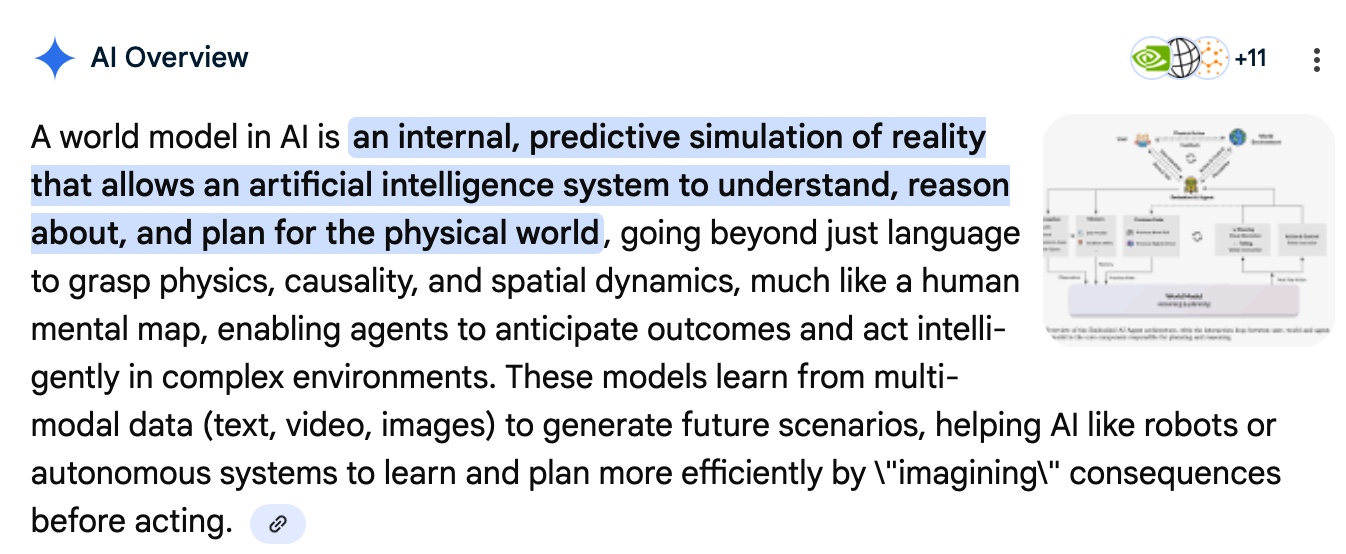
It's always interesting to see how the google view presents its results. Today I googled 'world model' and was surprised to discover that the Algorithm sees it as a term in the AI lexicon: AI's 'World Model(s)' captures some of what I found in that intersection of semantic fields.
And here's the AI summary:
Yann LeCun is often noted as a primary exponent of AI 'world models". Here's what google's Ai Overview says:
Yann LeCun's vision for world models involves creating AI systems with internal "simulators" that learn the underlying physics and dynamics of the world from sensory data, enabling them to predict outcomes, plan complex actions, and reason beyond statistical patterns like LLMs. He believes these models, which learn intuitive physics (like gravity, object permanence) similar to humans and animals, are crucial for achieving human-level intelligence, going beyond current LLMs' limitations in understanding causality and planning, and even leading to new AI architectures within years. LeCun's approach emphasizes learning in a latent space (like his JEPA framework) for efficient prediction, moving away from pixel-level reconstruction, and involves developing AI that can understand the world's structure and dynamics to invent solutions.Key aspects of LeCun's world models:
How they work (simplified):
- Internal simulators:
- They act as internal "simulators" of the world, allowing for prediction and planning.
- Learning intuitive physics:
They develop understanding of concepts like gravity, inertia, and object permanence, similar to infants.- Beyond LLMs: They address the limitations of LLMs, which struggle with true reasoning, physics, and complex planning, focusing instead on statistical next-word prediction.
- Latent space prediction: Focuses on predicting representations in an embedding space rather than raw pixels, using techniques like JEPA (Joint Embedding Predictive Architecture).
- Long-term planning: Enables complex, multi-step action planning in unfamiliar situations.
- Future of AI: LeCun predicts world models will become the dominant AI architecture, replacing current LLM-centric approaches within a few years.
- Startup efforts: He's involved with startups developing these technologies, emphasizing their potential over current language models for true intelligence.
Observe: The model takes in sensory data (like video). Encode: It compresses this into a latent representation (a compact summary of the world state). Predict: It predicts future latent states based on current states and potential actions, learning the world's dynamics. Plan: It uses this predictive simulator to plan actions that achieve goals, essentially "trying out" scenarios internally. Why they matter:
- They allow AI to learn how the world works, not just what words follow each other.
- They enable reasoning, invention, and robust planning, crucial for general intelligence.
- They are seen as the pathway to more capable and truly intelligent AI systems.
The AI aspect of 'world model' is interesting to explore, but I'm much more interested in the process of articulation of a personal World Model, so I need to explore the versions and aspects of World Model that I am and have been entangled with.
The foundational elements are geographic and explicitly global, traceable to a very early memory of exploring the globe, prominently displayed on a table in the 42 Quincy Street living room, and to the National Geographic maps that graced the staircase to the upper floor of the house. I fancy that I spent hours looking at those. And I had an Atlas of North America, from which I absorbed the idea that stuff flows across physical landscapes. My own immediate surroundings were seen in the Cambridge map...
Among the separable senses of 'world model' that I've engaged with:
Three-world model Wikipedia
World dynamics revisited: a realistic world model simulation Chaweng Chagchit and Joe H. Mize Socio-Economic Planning Sciences 1990This paper investigates and reviews the world models introduced by J.W. Forrester of MIT. A survey of responses to the model and current trends in the global modeling approach are also provided.From the review, it is noted that the assumptions used in the MIT models tend to reflect a generally pessimistic point of view. On the other hand, several critics of the models tend to be overly optimistic. This paper presents a modified world model in which two new variables (technology and pollution abatement) are introduced into (he original model, adding to the existing variables (natural resources, population, pollution, capital investment and agriculture).
Data check on the world model that forecast global collapse Gaya Herrington The Club of Rome (2021)
In the 1972 bestselling book Limits to Growth (LtG), the authors (Meadows, Meadows, Randers & Behrens) concluded that if humanity kept pursuing economic growth without regard for environmental costs, global society would experience sharp declines in available food, standards of living, and ultimately the human population, within the 21st century.The LtG authors used a dynamic systems model, World3, to study key interactions between global variables for population, fertility, mortality, industrial output per capita (p.c.), food p.c., services p.c., nonrenewable resources, and pollution. World3 is based on the work of Forrester (e.g, 1971; 1975), at the time a professor at MIT and the founder of system dynamics: a modeling approach for the interactions between parts of a system, which often produce non-linear behavior like delays, feedback loops, and exponential growth or decline.
Do we have an internal model of the outside world? Michael F Land Philos Trans R Soc Lond B Biol Sci (2014)...Space appears as continuum, independent of the objects that from time to time populate it. It is the continuum rather than the particular contents that appears to remain still when, for example, we look around a room. On this view, our consciously perceived phenomenal world is a hybrid: the machinery of the precuneus provides a temporarily stable and sparsely populated world model, which we can use as an index for finding the sources information we need for actionPrinciples of Modeling: Real World - Model World Tony Starfield(pdf)
...the four basic elements of model construction:
(1) the real world, which we attempt to model
(2) the model world, which is a simplified version of the real world
(3) the model, containing the working parts to run the model
(4) the data, which is required to run the modelFundamental concepts of a world model? Interactive Fiction Community Forum
All that gives us some idea how 'world model' is being used as a concept in several realms, but it doesn't connect very well with what I thought I meant when I started to consider my 'world model' and how it draws upon MYKeywords, or help much with a Narrative of how my 'world model' has developed.
18x25
On 15vii25 I noted:
What Education should be aimed at is the learner's Development (a Process) of "a world model". It's really not that one "world model" is CORRECT, but that there might be many that exist, all working toward 'best' for the individual learner's own ...needs? purposes? And the point is to be continuing to BUILD one's own.and on 17vii25:
MY world model has its feet in the physical and the biotic, in geography and ecology and temporal processes in which Homo sapiens is engaged...MY world model involves Systems in which life is susceptible to human control, with the caveat of discounts for hubris, error/omission, and short-sightedness... [This was] a product of Whole Earth involvement/influence, during the Stanford years, and via CoEvolution Quarterly and Whole Earth Review through the 1970s.
It occurred to me to begin to collect a World Model bibliography of books on my shelves that could have a productive conversation if they were gathered together on a cart (and perhaps grouped by birds-of-a-feather affinity):
Field Guide to the Patchy Anthropocene: The New Nature Anna Lowenhaupt Tsing et al. (2024)Man's Role in Changing the Face of the Earth William Thomas (1956)
Something New Under the Sun: An Environmental History of the Twentieth-Century World JR McNeill (2001)
What is Environmental History? J Donald Hughes (2015)
An Environmental History of the World: Humankind's Changing Role in the Community of Life Donald Hughes (2010)
Ecological Imperialism: The Biological Expansion of Europe, 900-1900 Alfred W Crosby (1993)
Europe and the People Without History Eric Wolf (1982)
World-Systems Analysis: An Introduction Immanuel Wallerstein (2004)
A World-Systems Reader: New Perspectives on Gender, Urbanism, Cultures, Indigenous Peoples, and Ecology Thomas D Hall (2000)
Friction: An Ethnography of Global Connection Anna Lowenhaupt Tsing (2024)
The Great Acceleration: An Environmental History of the Anthropocene since 1945 JR McNeill (2016)
Environmental Anthropology: A Historical Reader Michael Dove (2007)
Geographies of Global Change: Remapping the World RJ Johnston (2002)
Changing the Face of the Earth: Culture, Environment, History Ian G Simmons (1996)
The Human Impact on the Natural Environment Andrew Goudie (2000)
Technology: A World History Daniel R Headrick (2009)
The Atlas of a Changing Climate: Our Evolving Planet Visualized with More Than 100 Maps, Charts, and Infographics Brian Buma (2021)
The Systems View of Life: A Unifying Vision Fritjof Capra and Pier Luigi Luisi (2016)
The Great Derangement: Climate Change and the Unthinkable Amitav Ghosh (2017)
Thinking in Systems Donella H Meadows (2008)
Limits to Growth: The 30-Year Update Donella Meadows (2004)
Spatial organization: The geographer's view of the world Ronald F Abler et al. (1971)
In the World Interior of Capital: Towards a Philosophical Theory of Globalization Peter Sloterdijk (2013)
(there will be more)
20xi25
Adam Tooze quotes Peter Sloterdijk::
...After a start-up phase of several centuries, the world system is increasingly stabilizing itself as a complex of rotating and oscillating movements that maintain themselves on their own power. In the realm of circulating capital, momentum has overtaken reasons. Execution replaces legitimation, and facts have become forces majeures. Anyone speaking of globalization could just as easily refer to 'destiny'... Briefings have replaced critique....Being-in-the-world has always had elements of an overwhelmingly extended non-consideration-of-whatever-cannot-be-integrated. One of the outstanding mental effects of 'globalization' is the fact that it has made the greatest anthropological improbability — constantly taking into account the distant other, the invisible rival, the stranger to one's container — the norm. The globalized world is the synchronized world; its form is produced simultaneity, and it finds its convergence in things that are current.
There are no more time-outs in the disclosed and depicted global space. ..."Mankind" — it enters the stage of contemporary thought in a state of progressive self-discovery and interconnection as the vague and splintered para-subject in a universal history of the coincidental.
Images and my World Model
The first visual source that I can definitely identify as foundational in my developing World Model is certainly The Family of Man, which I remember being enthralled by around 1955, and have returned to many timesIn the late 60s and early 70s (indeed, through the 1980s) I was inspired by the empyrean perspective of aerial photography and satellite imagery...
The Earth from Above Yann Arthus-Bertrand (2002)...an eclectic range of natural wonders and man-made oddities captured by both luminaries and amateurs alike in the burgeoning drone-photography community ...Both low- and high-level aerial photographs document places around the world and form the starting point for discussions of ecology, sustainable development, and the current state of the world.Man on Earth Charles Sheffield (1983)
Earth Watch : A Survey of the World from Space Charles Sheffield (1981)
Aerial Muse: The Art of Yvonne Jacquette Hilarie Faberman (2002)
Aerial Geology: A High-Altitude Tour of North America's Spectacular Volcanoes, Canyons, Glaciers, Lakes, Craters, and Peaks Mary Caperton Morton (2017)
In recent years, I've been inspired by a collection of landscape photography books, including
Spina America Richard SharumAmerican Geography Matt Black
...a vivid portrait of an unknown America, to photograph some of the poorest communities across the US. Traveling across forty-six states and Puerto Rico, Black visited designated "poverty areas," places with a poverty rate above 20 percent, and found that poverty areas are so numerous that they're never more than a two-hour's drive apart, woven through the fabric of the country but cut off from "the land of opportunity." American Geography is a visual record of this five-year, 100,000-mile road trip, which chronicles the vulnerable conditions faced by America's poor.American Geography: Photographs of Land Use from 1840 to the Present Sandra S Phillips and Sally Martin Katz (2021)
...this compilation offers an increasingly nuanced perspective on the American landscape. Divided by region, these photographs address ways in which different histories and traditions of land use have given rise to different cultural transitions: from the Midwestern prairies and agricultural traditions of the South, to the riverine systems in the Northeast, and the environmental challenges and riches of the far West. American Geography also looks at the evidence of older habitation from the adobe dwellings and ancient cultures of the Southwest to the Midwestern mounds, many of them prehistoric.Property Rights Mitch Epstein (2021)
Who owns the land, by whose authority, and with what rights? Mitch Epstein examines the American government's ongoing legacy of property confiscation, and how communities gather to resist...Mitch Epstein (born 1952) has photographed the landscape and psyche of America for half a century
Manufactured Landscapes: The Photographs of Edward Burtynsky (2003)
Changing the Earth Emmet Gowin (2002)
Emmet Gowin has been taking aerial photographs of the landscape in the United States, Mexico, Czechoslovakia, Asia, and the Middle East for over twenty years. In his most compelling photographs, one witnesses how man's footprint has visually scarred and continually altered the earth's surface....images of military test sites, missile silos, ammunition storage and disposal facilities, coal mining, pivot irrigation, offroad motor traffic, and more. The book also surveys his more recent works, which focus on other regions of the world, including the battlefields of Kuwait, new golf courses in Japan, and the chemo-petrol industries of the Czech Republic.
Topographies: Aerial Surveys of the American Landscape Stephen Shore (2023)
...a series of photographs shot by drone from 2020 onwards, which reveal in arresting detail the interplay of natural and man-made landscapes in Montana, North Carolina, New York, and beyond.Eyes over the World: The Most Spectacular Drone Photography Dirk Dallas
...an eclectic range of natural wonders and man-made oddities captured by both luminaries and amateurs alike in the burgeoning drone-photography community.and here's one I'd really like to add:
New Topographics Britt Salvesen (2026)❧ ❧ ❧ ❧ ❧ The concept of hyperobjects found me via Hyperobjects: Philosophy and Ecology after the End of the World Timothy Morton (2013) (see my Kindle Notebook
) Atmosphere, Weather and Climate Roger Barry and Richard Chorley
❧ ❧ ❧ ❧ ❧
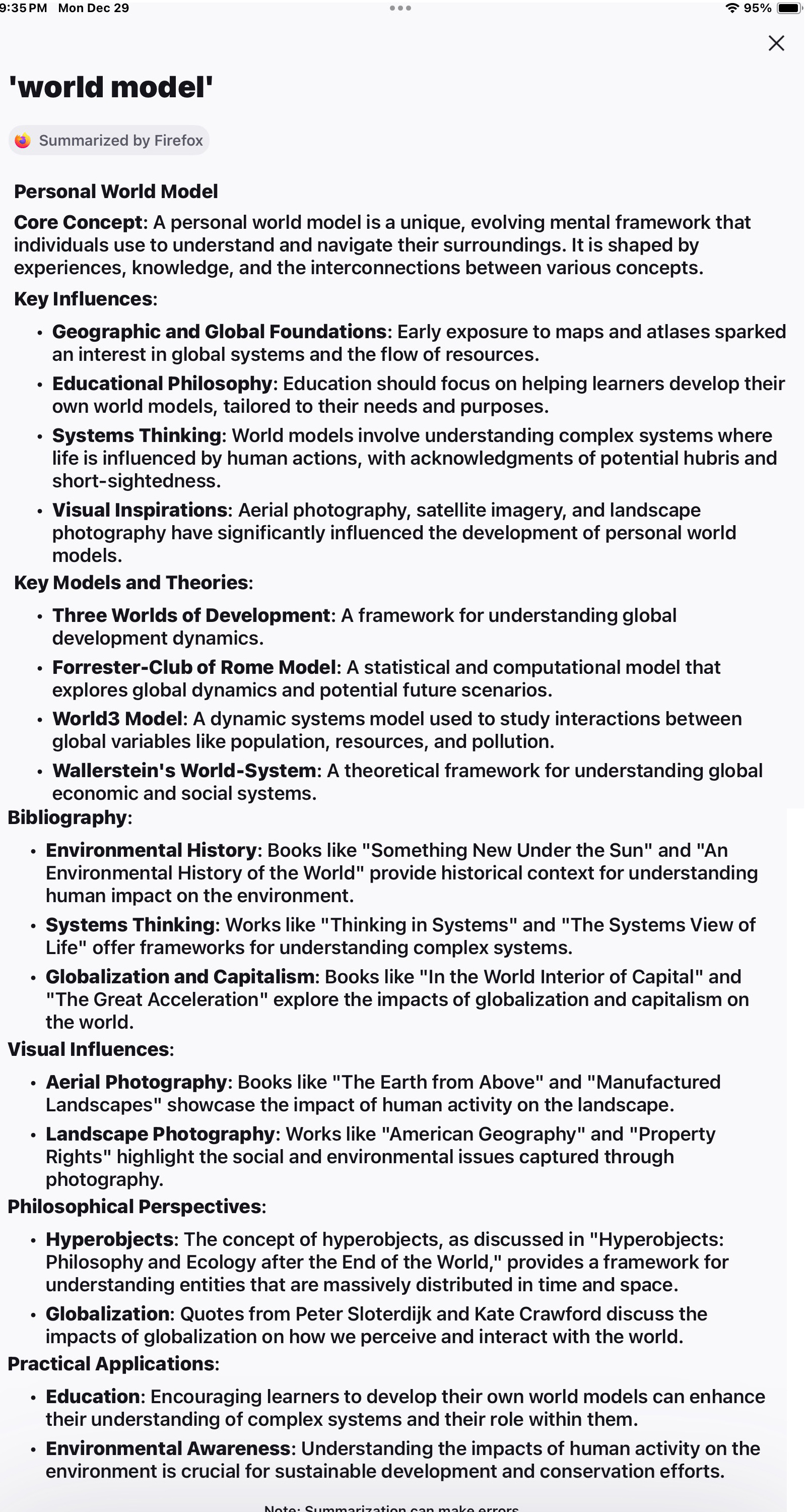
what Firefox thought the Page said on 29xii25, after a day of augmentation/editing: 3ii26
Today Edward Burtynsky's The Great Acceleration arrived in the post
..."The Great Acceleration" is an established term used to describe the rapid rise of human impact on our planet, among them population growth, water usage, transportation, greenhouse gas emissions, resource extraction and food production, each of which Burtynsky has photographed the signs of in great detail throughout his career. From open pit mines across North America to oil derricks in Azerbaijan, from rice terraces in China to oil bunkering in Nigeria, Burtynsky has traveled the world and back again as part of his restless and seemingly inexhaustible drive to discover the ways, both old and new, that organized human activity has transformed the earth.
(Amazon blurb)The photographs are very eloquent with respect to the 20th and 21st century Hand of Man, and the picture is grim and distressing. If I was teaching Human Geography in 2026, it's the sort of imagery I would use to provoke thought and open questions... ship-breakers in Pakistan, miners in the Congo, mountains of tires in ...well, anywhere. Such things simply must be factored into the personal World Model espouse.
4iv26
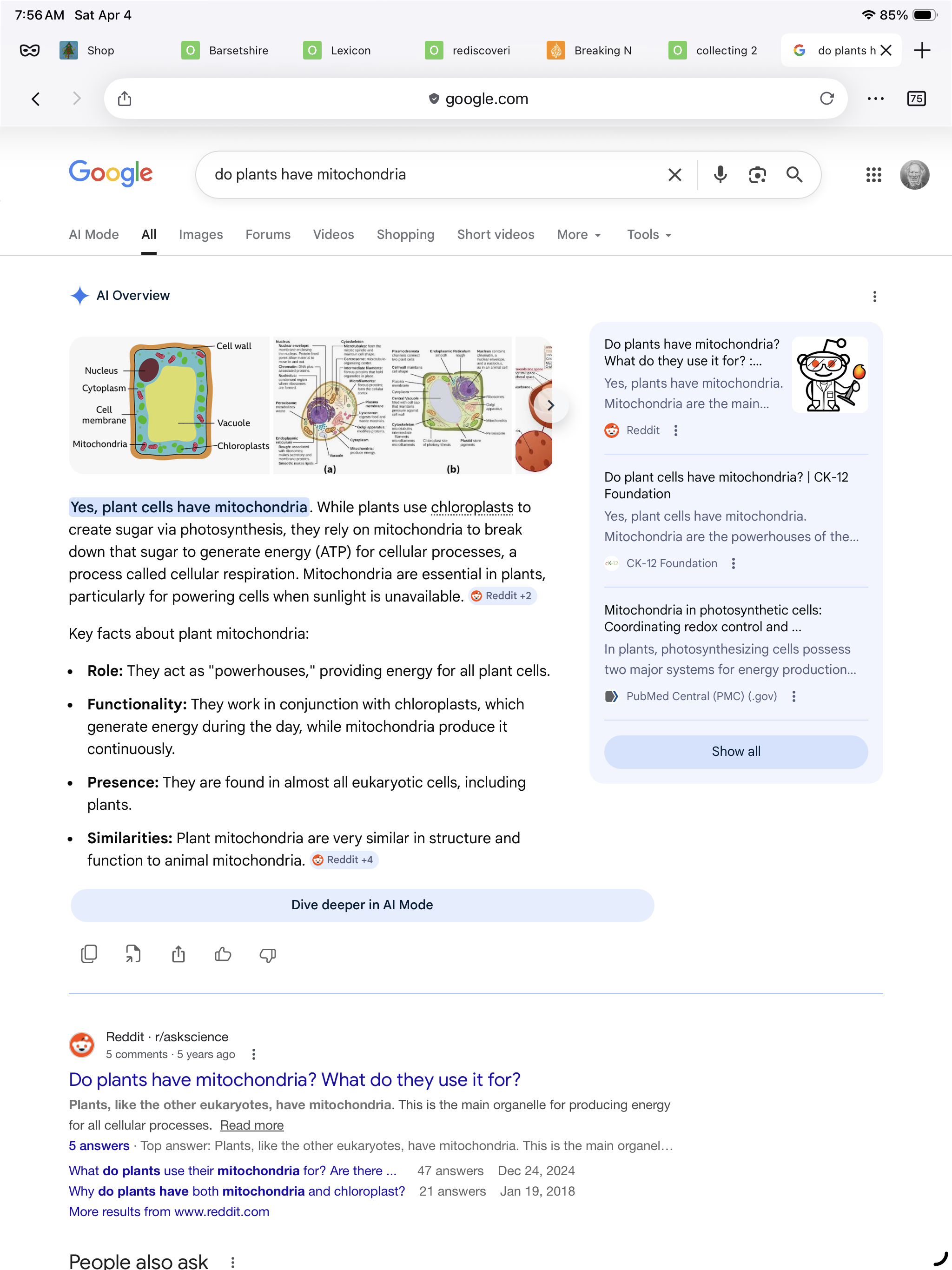
mtDNA fits somewhere in the Biology/Life Sciences sector
Haplogroup U8a1a in Central Asia Victor Mair at Languuage Log
Human mitochondrial DNA haplogroup Wikipedia
Distribution maps of mitochondrial haplogroups in Europe, the Middle East and North Africa eupedia.com
https://www.sciencedirect.com/topics/biochemistry-genetics-and-molecular-biology/mitochondrial-haplogroup ScienceDirect.com
Characterization of mitochondrial haplogroups in a large population-based sample from the United States Sabrina L Mitchell et al. Human Genetics (2014)
Mitochondrial DNA haplogroup, genetic ancestry, and susceptibility to Ewing sarcoma Kriistiyana Kaneva et al. Mitochondrion (2022)
...The mitochondrial genome is present in hundreds to thousands of copies in each human cell and inherited only from the mother (Aryaman et al., 2019). Human mitochondrial DNAs (mtDNAs) have acquired many mutations that segregated during the evolution and dispersal of modern human populations (Wallace, 2015). Different sets of these mutations can be used to classify mtDNAs into haplogroups, or maternal lineages, reflecting their genealogical or phylogenetic relationships to each other.Mitochondrial Eve Wikipedia
The myth of Eve: molecular biology and human origins F J Ayala Science (1995)
Talking with Lina Khan Paul Krugman
...the Amazon paper similarly resulted from doing a lot of business and market research. I spent a lot of time talking to two sets of market participants. One was the set of businesses that were selling through Amazon, and the second was investors and financial analysts that were looking at Amazon more through a long-term financial prism. And this was around 2012, 2013. The kind of common policy wisdom in DC was that Amazon, along with these tech giants, you know, had revolutionized digital markets, that Amazon in particular was, you know, somewhat irrational. It kept losing money, it seemed to be, you know, relentlessly dedicated to making things cheap. And so the idea that Amazon could ever pose some kind of competition problem didn't really compute for people, because we had come to interpret our antitrust laws primarily through the prism of what the effect on short-term prices would be. And so I ended up using a lot of that research to basically use Amazon to tell a broader story about how various changes in how we now do antitrust had created all sorts of blind spots. You know, some of the core business practices that Amazon used to develop its network, to deepen its moat were business practices that in the ‘60s or ‘70s would've been viewed pretty skeptically by law enforcers. But because of this intellectual revolution that had been, you know, spurred by people like Robert Bork, by people kind of generally known as the Chicago School, that we were now oftentimes facilitating the very types of concentrations of power that these laws were supposed to be skeptical of. And so the article was about Amazon and about Amazon's business practices, but it was really using the company to tell a deeper story about blind spots that I thought the current antitrust regime had....the piece came out in January or February of 2017, and then that summer, Amazon announced it was planning to buy Whole Foods. And I remember that was one of the first moments where the response to one of these big acquisitions seemed a little different, because it seemed to prompt this question for the public of, are there any limits, and what are those principles?
And so I remember that acquisition ended up spurring a lot of discussion in particular.
Krugman Yeah, I mean, what strikes me is that the idea that companies that have established these kind of network positions, these kind of centrality and everybody has to use them, that they would abuse that, seemed, you know, not many people were saying that 10 years ago. And nowadays it's everywhere. It's, I mean, the word of the year I guess like three years ago was Cory Doctorow's enshittification, which was basically largely about Amazon and Facebook and all of these companies abusing their sort of central position in markets. And do you feel vindicated by all of that?
Khan You know, it's good that there's been collective learning about, you know, the challenges that these firms can pose, you know, resulting in major lawsuits being filed. You know, Google has now been found to be an illegal monopoly, you know, three times over in separate cases. The case against Amazon is still proceeding. So yeah, I mean, you know, I do think that there's been a greater awareness of how these markets in particular can be prone to monopolization, right?
...think one of, the big shift was that in the early 2000s, there was a view that to set up one of these companies, all you need is, you know, a couple of high school dropouts in a garage with a good idea. And that the entry costs were very low, and that, if anything, the government should err on the side of inaction because these markets were so fast-moving, so dynamic that we didn't want these, you know, arrogant government officials to start meddling. And so there was a, you know, almost a deliberate policy choice to err on the side of inaction from an antitrust and competition perspective. And I think, you know, fast forward even a decade from that time, there was a much greater recognition that actually there's something about how these digital markets work, this concept of network effects, the ways that data advantages kind of reinforce themselves, that maybe these markets are even more prone to monopolization rather than less. And so maybe there should be more action and more scrutiny earlier. And so I think there was an inversion of some of those prior assumptions. – Krugman Yeah, for people in the audience, network effects here really means that there's a lot of these companies' services that everybody uses, because everybody uses them, right? There's a sort of circularity. I mean, you know, as many of us know, it's really, really hard not to buy from Amazon now, and this is true of a lot of these companies. And you were talking about that quite early as a risk at a time when people were mostly praising it.
...the FTC is by all accounts a pretty small agency. At its peak when I was there, it was around 1400 employees. And so we had to be extraordinarily focused on prioritization, and, you know, every investigation you're doing is another investigation you're not doing. So there were several factors that we looked at, one of which was just how significant is this industry for people's day-to-day lives? And something that rose to the top of course was healthcare, where across different parts of the healthcare supply chain, we have similarly seen a lot of consolidation, be it among hospitals, be it among pharmacies, be it among these middlemen known as pharmacy benefit managers. And in healthcare in particular, we've seen not only horizontal consolidation, but also vertical integration. So the same player that is the health insurer is also owning the pharmacy, is also owning the pharmacy benefit manager. We'd also seen trends such as private equity coming in and rolling up different physician practices and then jacking up prices. And, you know, week after week, month after month, we would hear from Americans about just how devastating this was for their day-to-day lives. I mean, we would routinely hear from people about how they were having to ration lifesaving medicines, skip doses of lifesaving medicines, people who had had family members pass away because they didn't wanna, you know, use up all their insulin because it was so expensive. And so the kind of stakes here are literally life or death. And so we spent a lot of time focused on healthcare markets. That included things like whenever pharmaceutical companies were trying to merge or buy one another, we would be especially vigilant to make sure that these mergers were not gonna be used to snuff out new innovative drugs that actually would have brought down prices.
...there were some of those, there were some sort of scandalous acquisitions and then exploitations involving drugs. I'm trying to remember now. I'm sure you know better than me. But there were some really drastic cases that made headlines. And did you feel that you made headway on those?
Khan Yeah, I mean, you know, one of the most notorious was Martin Shkreli, AKA Pharma Bro, who, you know, bought up a drug and jacked up the price thousands of percent. And you know, that was a case that the FTC litigated, the FTC won, and then also secured a lifetime ban for Martin Shkreli, where he is not allowed to be in the pharma industry anymore. There's some other cases that are still ongoing in healthcare, but we did successfully stop hospital mergers across the country. There's a lot of evidence that when hospitals merge, prices and costs tend to go up and quality tends to go down. We've also seen the rise of healthcare deserts across the country, where, you know, people are gonna have to drive, you know, over 100 miles to get to the nearest hospital as opposed to 10 miles. And so, you know, there's a lot more work to be done there, but there was some progress.
13iv26
Of Hydrogen Bonds and Protons Small Things Considered
quoting Stent (1965)
"..by the time of the Mendel Centennial in 1965 the nature of the gene was understood. Alas, the physicists were to be cheated out of their reward: no 'other laws of physics' had turned up along the way. Instead, as the facts to be set forth in this book will show, the making and breaking of hydrogen bonds seem to be all there is to understanding the workings of the hereditary substance
Imbrications: MYKeywords in re: World Model
(from Clusters)
WORLD MODEL 16x25Culture
Ecology
Imagination
infrastructure
landscape
map
paradigm
Pattern
process
synoptic
Systems
trajectory...and on 12iv26 I added
cyber-
dynamic
emergence
hyper-
Narrative/Story
technēOn Non-Viable Worldviews Eric Lee at Medium
...There are over 8 billion worldviews and counting, and no compartments within brains, though each is bounded by a skull. My worldview as an infant is not the one I have now at 73, with daily changes between the then and now.