(see a lesson learned (7ii18)
the drama continued (14ii18)
Bodhisattva manifests (27ii21)
of which this is a continuation)
September 2026 general links
(continues August 2026 links)
Many of these seem to be bellwethers for what's on and just beyond the Horizon of the moment,
collected from the Incoming for their portentous savor, and illustrative of my engagement with serendipity)
The form factor I seem to gravitate toward is The Commonplace Book, a now-digital place to entomb snippets that seem at the moment of encounter to want saving, often as prime examples of some form or genre to which my attention has been drawn. Most offer temptingly yawning Rabbit Holes, and these collections of links form a sort of map of my wanderings and encounters.
1ix26
The Age of the Third Brain JA Westenberg
...The memex was never built, but the idea kept circulating for decades, picking up momentum each time the information environment became denser and more demanding. By the 2010s, when smartphones made access to knowledge ambient and information overload became a clinical complaint, the idea finally found a name that stuck: the second brain.For most of a decade, people — like me — built them obsessively, maintained them inconsistently, and gradually accumulated a guilty feeling that we were doing something wrong, without quite being sure what.
What I didn't understand then, and think I understand better now, is that the second brain was never really a product problem. It was a layer problem. The first brain has characteristic strengths and characteristic failures. The second brain was designed to compensate for those failures.
But the second brain had its own characteristic failures that no amount of organizational discipline could fully address, and that required a different kind of compensation entirely.
The third brain — AI working on top of both the first and the second — is that compensation.
...serious intellectual work has always needed some form of external scaffold, because it depends on exactly the kind of structured, persistent, arbitrary-sequence-accessible storage that biological memory is poorly suited to provide
...your biological brain is not equipped to store and retrieve the volume of material a contemporary knowledge worker encounters, so you need a trusted external system that functions as a second brain, capturing ideas, organizing them, and surfacing them when relevant. The framework he called PARA, which organized everything into Projects, Areas, Resources, and Archives, gave people a way to stop improvising their organizational logic and start building something consistent.
...AI that has access to your second brain, your notes, your captured thinking, your annotated reading, your past writing, your in-progress ideas, is something qualitatively different. It can do what the second brain promised but couldn't deliver: retrieve relevant material at the moment of need, surface connections you wouldn't have made, synthesize across everything you've captured, and do all of this without requiring you to have maintained a perfect organizational discipline in the first place.
...What I have provisionally landed on is that the three layers are less like distinct modules and more like layers of a single extended cognitive Lasagne (forgive me), where each layer compensates for the characteristic failures of the one below.
The first brain is fast, associative, and emotionally intelligent — but painfully forgetful. The second brain is infinitely persistent and organized — but entirely passive, demanding endless manual upkeep. The third brain is a tireless engine for retrieval and synthesis, but it lacks the critical judgment that makes those things valuable. It can't tell you what actually matters or what should change your mind.
But I don't think the goal is frictionless output.
Or at least, I don't think it should be.
We have to intentionally engineer friction into the system, at least on some level, to make sure we're still actually thinking
Nested Worlds Andy Ilachinski
Form Finds Form
"Form finds form" is a phrase meaning that the process of creating or thinking helps shape its own expression; the thought finds the language, and the language finds the thought.Origin and Meaning
Ann E. Berthoff: The educational theorist and writer popularized the phrase, using it to describe the organic composition process in writing and art.Core Idea:
Meaning and structure do not exist separately before creation. Instead, as you work through a medium (like writing, design, or art), the shape of the idea emerges naturally through the act of making it.Bodhisattva manifests (27ii21)
Form Finds Form mi-e (2x18)
2ix26
The Two Varieties of Human Eric Lee at Medium
... I view myself as a Homo sapiens subspecies (unlike anthropologists, most human scientists/humanists, and Wikipedia editors), and to do the forbidden, I'll add taxonomic levels below subspecies that botanists get to use: variety (var.), subvariety (subvar.), form (f.), and subform (subf.) as needed. So at the variety level there is the expansionist form of human (var. narrator, aka the modern variety characterized by a linguistic/cognitive mutation that overvalues story above the what is told of using slithery words)....By 'modern human' (the variety Tom Murphy calls 'metastatic modernity') I refer to all expansionist humans that descended from a small ancestral population (e.g. Euna & Auno) c. 75 kyo (thousand years ago) as Early Modern Human (EMH) hunter-gatherers (H.s. sapiens var. narrator subvar. emh), some of whom c. 23-12 kyo became Mid Modern Human (MMH) agrarians (H.s. spaiens var. narrator subvar. mmh), and Late Modern Humans (LMH) dependant on industrial society, i.e. the Modern Techno-Industrial (MTI) form of society and civilization, whose citizens are now dependant on fossil fuels post Wood Age (16th and 17th centuries of European industrialization).
The MTI form of civilization with its more distal beginnings as Proto-Indo-Europeans c. 7k BP is now global having its proximal origin c. 800 CE post-Western Roman Empire dissipation and reboot when the warlord Charlemagne was crowned Emperor of the Romans by Leo III, the first political Pope of the early medieval period, who formed the Holy Roman Empire (aka metastatic modernity late phase) that was neither holy, Roman, nor an empire when it formed.
By the 21st century the outlying populations of other peoples had been assimilated into the world socioeconomic-political system of no sovereign powers.
That pre-expansionist normal humans could go to a region, e.g. Madagascar, and live within limits to avoid degrading their habitat, unassociated with any megafauna extinctions, was as evidenced. Then the expansionist variety came to Madagascar that rapidly caused the extinction of all megafauna (first Austronesian expansionists, then Bantu and others more recently), including the pre-expansionist variety (likely Khoisan), replacing them with itself and livestock as the only current megafauna on the island. To me, the two varieties look different (normative vs metastatic).
There is evidence that the pre-expansionist variety of human can manage their demands on Nature's resources and not do what we do as a serially invasive species, but I know of no prior examples of modern humans systemically managing their demands on Nature's resources with the possible exception of a remnant population of the phase 3 Tairona civilization.
...For 9 thousand years human habitation was not associated with habitat degradation (exceeding of carrying capacity) nor any species extinction. If human remains dated to prior to the known Austronesian/Bantu presence are found and DNA recovered that was not Khoisan, then my inference that the failure of humans to act like modern humans for 9k years due to being pre-expansionist Khoisan normal humans (mainland African population from 260k to 150k BP with arrival of Bantu expansionists c. 3.5k BP to early 21st century cultural extinction) would be falsified, rejected.
...By 2012 archaeogeneticists had determined that all known human populations, except for Khoisan and Pygmy, shared a common ancestor from a small population now dated to c. 75-76 kyo (likely arising among atypical hunter-gatherer permanent settlements at shellfish beds on the southern tip of Africa and so not arising within the Khoisan nomadic population).
...The lack of genetic diversity is a defining modern human feature together with behavioral modernity not found or rare in the Khoisan (e.g. suicide, war, genocide, all 'diseases of civilization' with homicide rare, e.g. secondary to a woman with two suitors who refuses to choose between them).
The Seven Coolest Inventions From 'DEF CON' 2026 lifehacker
...There's a device that detects nearby Flock cameras, an encrypted handheld device for sending texts without relying on carrier networks or the internet, a risk calculator for third-party web browser extensions, and an advanced spyware detector for smartphones.
The Viking Alliance Is Coalescing Brad DeLong
...What Canada triggered, what Sweden walked through, and is now gelling as what Narayan calls the Coalition of the Doing and I call the Viking Alliance is the creation of a new, second potential anchor for the NATO-EU portion of the open international order. What Canada and Sweden and Germany and Ukraine; plus Poland, Lithuania, Latvia, Estonia, Finland, Norway, Denmark, Holland, France, and Britain; are doing is building-up an advance guard with a durable, standing capability for military action inside Europe. Procurement, logistics, industrial base, command: the whole stack. And this advance guard's capability, when built, does not at any point in the causal chain route through the Washington, DC currently controlled by a bunch of grifters, neofascists, and chaos monkeys. An alliance with one indispensable leader is a hub-and-spoke. Hub-and-spokes are brittle exactly where they look strongest. Capture the hub and the thing collapses. But an alliance with two credible centers of gravity in initiating force commitment is a network with redundancy. For the first time since 1945 there exists a plausible answer to the question "and if the Americans don't come?" that is not simply "then we lose."There is irony here, entirely lost on the people who spent a decade demanding Europe "pay its fair share" have gotten their wish: the United States in foreign affairs no longer has its weight multiplied by NATO to the dominant strength of 1,000,000,000 people living in the rich industrial civilization, but only its own 350,000,000.
Zen Patriarchs
(see a lesson learned (7ii18)
the drama continued (14ii18)
Bodhisattva manifests (27ii21)
of which this is a continuation)
3ix26
Godzilla El Niño vs The Gentle Singularity on our difficulty with non-human agency Pete Chambers
...'The Thing' about non-human agency is that it is not aligned with human knowledge or human interests. This is less an 'alignment problem' (as if the non-human could be brought into and kept 'in alignment') than it is a failure to imagine the non-human nature of the nonhuman. A virus is, after all, 'just' a mechanism for its own replication. An agent, or a 'swarm' of agents, is 'just' a program being maxxingly persistent in the pursuit of its narrow goal, which it enacts by being continually prompted by the LLM (Harry Ellis). In the same way, the Grand Canyon is 'just' erosion, and Australia's current position is 'just' plate tectonics.
...The goods life is (still) supplied by the pipes: the pipe of water and sewage, the pipe of water and electricity, the pipe of stuff made out of whatever fits into 33-34 million TEU, and the pipe of signs, where tiny flashes of winking light are beamed along microscopic glass pipes running across the ocean floor, delivering slop and lolcats and bank statements and photos of loved ones.
...Involution means change without progress: the pace and scale and imbrication of entities and events mean that shit is getting faster, bigger, and is clumping together, like fairy floss and a fatburg. This makes us feel dizzy, queasy, alienated, lonely, terrified, exhilarated, lost. We live in interesting times… and involution means that that this is happening as institutions unspool, groups and individuals unravel, things 'snap, but continue2' (instead of bending not breaking).
Much of what limps is broken, yet goes on and on. The middle has gone missing — from class, from classes3, from mental health — and therze's only the escalating swirl down. So — if we still have such precarious privileges — we keep going to work, keep enrolling in university courses, keep voting, keep filling our cars up with diesel and blasting around on planes. Involution itself keeps on chugging, and it keeps on chugging away at things that were good, or intact, leaving only beacons and niches in deadzones full of metaphorical Nomura jellyfish. The Dead Zone is a sign of the times.
...3SD is my own made-up drug: a synthetic compound made by glomping surreality, stubbornness and stupidity onto dumb, dangerous, destructive habits and patterns that have been on foot for a while (see above on involution). In a sense, 3SD is kinda the pill, and kinda the name for a set of effects we experience as we choose to react involution through more consumption, more expansion, more escalation, more accumulation.
3SD is a made-up peptide — available online here — that, in a sense, both causes maxxing and causes maxxing to make sense to people — as a way of dealing, in a 3SD way, with what 'all of the above' is doing to our selves and our society.
extimate, and can be head-meltingly confusing, in another sense we know very, very well where we're at. And it is knowable. Reality is complex, but it is not unknown. At the level of global systems, as we explored, it's hockey stick after hockey stick: up, and to the right, up and to the right. In 2026, we may be tarrying with maxxing, or snickering at Clavicular as maxxing's ultimate tragicomic avatar, but meanwhile, the systems boundaries are already maxed – and still we want to expand, escalate, accumulate, go to Bali-Japan-Italy-France for our global tourist experience, and buy our kids viral rare squishy dumpling toys, now that Labubu are unbearably passé (link to In conversation with Pete Chambers (1:42)
terms encountered:
Clavicular (influencer) WikipediaKoro (disease) Wikipedia
Koro-—the psychological disappearance of the penis PubMed
Conatus Wikipedia
Deontological Ethics Stanford Encyclopedia of Philosophy
Phenomenography in the 21st Century: A Methodology for Investigating Human Experience of the World Open Book Publishers
I Ditched My Bone-Conduction Headphones for These Noise-Cancelling Running Earbuds lifehacker
Jacques Lacan coined the neologism 'extimacy' (extimité) in order to theorize two interrelated modes of psychical apprehension: first, how our most intimate feelings can be extremely strange and Other to us. Second, how our feelings can be radically externalized on to objects without losing their sincerity and intensity. Attending to the socio-spatial dimensions of extimacy, this paper provides insight into the importance of topology in Lacan's work. In so doing, the paper challenges the enduring doxa in geography that Lacanian theories ultimately devalue the intricacies and liveliness of space. To substantiate this claim, I explore the extimacy of the most popular vehicle accessory in the USA since the 1980s' 'Baby on Board' signs: the 'ribbon magnet'. Specifically, I elaborate the extimate contours of two ribbon magnet slogans, 'Half Of My Heart Is In Iraq' and 'I Support More Troops Than You'. Affirming a recent critique that social and cultural geographers have 'tamed' psychoanalysis, that is, shied away from working through psychoanalysis's allegedly unseemly conceptualizations of politics and subjectivity, this paper suggests that we have yet to catch up with some of psychoanalysis's most fundamental and valuable theorizations about space itself.
Pace and Race Christopher Hobson
...Focusing on frontier', Gemini AI provided a solid overview:The word "frontier" evokes concepts of boundaries, unexplored environments, and the threshold between the known and the unknown. Its associations span physical geography, scientific inquiry, and cultural mythology. Geographical and Physical Imagery
- Wilderness and Landscapes: Vast, unsettled expanses such as deserts, dense forests, or mountain ranges.
- The Edge of Settlement: Outposts, border towns, and the physical line dividing populated regions from uninhabited territories.
- Outer Space and Oceans: The "final frontier," characterizing deep space exploration, planetary surfaces, or uncharted deep-sea trenches.
Historical and Cultural Concepts
Intellectual and Technological Ideas
- Pioneering and Expansion: The movement of populations into new areas, historically associated with the American West, covered wagons, and settlement.
- Lawlessness and Survival: Environments lacking established legal or social structures, demanding self-reliance and physical resilience.
- Manifest Destiny: Ideological concepts justifying territorial expansion and the conquest of nature or indigenous populations.
To state the obvious, the usage of 'frontier' in relation to AI tends towards this final set of technological meanings. For many others outside of that narrow world, however, it is the historical and physical imagery that more immediately come to mind. In particular, I would suggest boundaries and unknownness, a sense of threat and survival, lawlessness and violence — these are some of the ideas that resonate.
- Scientific Discovery: The cutting edge of research, representing unsolved problems in fields such as quantum physics, artificial intelligence, or medicine.
- Innovation and Progress: The pursuit of new methods, technologies, or artistic expressions that push beyond current paradigms.
- Opportunity and Risk: The dual nature of new domains, offering potential rewards alongside high levels of uncertainty and danger.
The Invisible Systems Holding Industrial Civilization Together Elisabeth Robson at Medium
We often describe our civilization in terms of what it produces — oil, coal, gas, cars, computers, skyscrapers, solar panels, medicines. But perhaps it is better understood as a civilization of maintenance....Every day, millions of people perform work that is almost entirely invisible. They monitor dams, inspect bridges, synchronize and adjust satellites, maintain weather stations, produce chlorine for drinking water, repair undersea communication cables, calibrate electrical grids, preserve seeds, vaccinate livestock, monitor invasive species, maintain refrigeration systems, and replace countless components that wear out.
Most of these activities attract almost no public attention because they succeed by preventing problems rather than solving crises. When they work, nothing happens. We've become so accustomed to this continuous maintenance that we mistake it for the normal state of the modern world. It's only when a process fails that we notice — a bridge collapses, or a chemical storage drum explodes killing 11 people, or screwworm reenters the U.S. after decades of being contained.
Most if not all of the conditions we now consider normal are not stable states. They are actively sustained by enormous flows of energy, materials, expertise, and organization.
We tend to imagine civilization as a collection of things, when in reality, it is a collection of ongoing processes, and most of those processes are about maintaining the things we build.
...I find the screwworm story fascinating because it is one tiny window into a world of invisible maintenance that surrounds us every day. Once you become aware of it, you begin to see civilization as an intricate web of relationships, technologies, institutions, and people, all working continuously to hold together a world that cannot possibly hold itself together because it is entirely unnatural. My go-to things fall apart story is the coming failure of hundreds or thousands of tailings dams, but the screwworms might give that story a run for its money.
...The greatest illusion of modernity is not that our civilization will last forever. It's that we have forgotten how much effort it takes to make today look "normal" and how utterly abnormal every second of every day of our modern lives actually is
Scientists Say a Key Trigger for Alzheimer's Damage Isn't Even in the Brain gizmodo
Preparing for a post-Trump internet Cory Doctorow
...As the Snowden disclosures showed, there has been a longstanding bipartisan consensus that the internet is a great tool for American surveillance, conducted against friend and foe alike....Compared to nukes, tech shutdowns are amazing. Thanks to Big Tech, America — and only America — can brick almost any country on earth, shutting down its administration, agriculture and industry without firing a single shot. The only thing that prevented this from happening was an American elite bloc that was playing an iterated game and saw more benefit from sharing in Big Tech profits as they looted and spied on the world, as opposed to grabbing territory while scaring the world into breaking all land-speed records to ditch American tech and pursue meaningful digital sovereignty.
...Trump is a sick, frail old man, who is not long for this world. When he goes, all bets are off: America will be at the mercy of warring factions who will deploy the coercion and bribery that turned Big Tech into Trump's geopolitical weapon in order to achieve their own purposes — which might well be even stupider, crueler and more unhinged than Trump's.
...The armed, organized maniacs who have seized power in America and who are cheering him on as he rampages all over the world, kidnapping leaders and dropping bombs on schoolchildren are not going to dig a hole, crawl inside it, and pull the dirt down on top of themselves.
Hippocampus and consciousness Ralf-Peter Behrendt Rev Neurosci (2013)
An important assumption concerning the physiology of consciousness is that all varieties of conscious experience are closely related to each other and, hence, are subserved by the same neural mechanism. There are several considerations that lead us to implicate the hippocampus in the generation of conscious perception and, ultimately, of conscious experiences of all kinds. Firstly, conscious perception of external events is intricately linked with the formation of episodic (declarative) memories, a key function attributed to the hippocampus. Secondly, conscious experience is allocentric and contextualized. Consciousness creates or simulates an image of the world that appears to surround us and to be independent of our observation of it. What is characteristic of wakeful consciousness and dreaming alike is that objects or events are experienced as being embedded in an external, that is, allocentric, frame of space and time. The hippocampus has been implicated in the rapid formation and memorization of allocentric representations that embed objects or events in a world context. Thirdly, the hippocampus is ideally positioned to bind information processed in different sensory association cortices. It is argued that rapidly forming patterns of neuronal ensemble firing in the hippocampus, particularly in region CA3, which encode arbitrary associations between objects and their spatiotemporal and emotional context, that is, associations between information derived from different neocortical processing streams, define the informational content of consciousness. Evidence suggestive of an important contribution of the hippocampus to conscious observation, mental imagery, dreaming, conscious anticipation of outcomes, and hallucinations will be reviewed.
10 Shows Like 'Dark Matter' You Should Watch Next lifehacker
4ix26
Science Friday
(Un)intended consequences of mass-prescribing GLP-1s...As the Ozempic era rapidly unfolds, however, commercial interests seem to be driving people in the opposite direction. GLP-1 market leaders, Eli Lilly and Novo Nordisk, are advancing a biomedical framing of obesity as a chronic, relapsing disease. Researchers funded by these companies recently proposed a new diagnostic category called "preclinical obesity" that could undermine collective prevention efforts by focusing the debate on obesity treatments for individuals instead. Amazon and online wellness platforms, including Weight Watchers, now offer telemedicine lifestyle programs for GLP-1 users and "same day delivery" schemes at costs out of reach for most. With massive profits at stake&mdash'Eli Lilly is the first health care company to reach a $1 trillion valuation—WHO's job of preserving equity in access and food environment reforms will prove more challenging....food companies seek to compensate for profit losses from declining consumption of ultraprocessed food by rebranding their products as "functional foods" for a GLP-1 lifestyle. GLP-1s offer a convenient reason to "shrinkflate" products for smaller appetites. And companies can further compensate for suppressed demand by reformulating products to increase palatability and alter food textures to increase chewing rates among GLP-1 users and nonusers. The food industry has a long-demonstrated capacity to turn health concerns into market opportunities, while deflecting attention from its role in the obesity epidemic. The Ozempic era could therefore have the unintended consequence of consolidating the food industry's market power, while perpetuating price inflation and unhealthy food environments.
How scientists unraveled the causes of the devastating flood in Tibet and Nepal
Fearing seal die-off from bird flu, Australia moves to evacuate sub-Antarctic research station
Lapham's Quarterly Archive and A neat project at work: We built an archive for Lapham's Quarterly
...There is a melancholy that permeates The Tale of Genji, which can be traced to the concept of mono no aware, or the sensitivity towards the fact that everything is transient and there is a sad beauty found in impermanence. This concept is still alive in present-day Japan, where cherry blossoms are viewed with the bittersweet knowledge that their beauty lasts only for a short while....Translating between unrelated languages is like creating a 2D map projection of a 3D globe, in that it's fundamentally impossible to be 100% accurate, and something has to give. While the cartographer has to decide how much of shape, area, distance, and direction to sacrifice, the translator needs to consider factors such as formality, fluency, structure and, in my opinion the most fundamental decision, whether to try to preserve the literal meaning or the emotional impact of the original. These tradeoffs are especially painful when it comes to poetry, where it's even harder to separate meaning and form. In poetry, the original form might have a specific number of syllables, or rhymes, or patterns of emphasis, which are necessarily tied to the language they were written in, such as the 5-7-5-7-7 structure of the traditional waka poem, and there is no objectively correct way to handle that in translation.
The Power of Being a Threshold Person: Liminality, Communitas, and the Anti-structures of Possibility Marginalian
"All things are so very uncertain, and that's exactly what makes me feel reassured," one of the Moomins observes in Tove Jansson's masterwork of philosophy disguised as a children's book. It takes a great spaciousness and sobriety of spirit to be vitalized rather than paralyzed by uncertainty. Most of the time, we brace behind structures of certainty to keep the native chaos of the universe, the fundamental indeterminacy and unpredictability of life, from drowning us in helplessness. But each time we part the bars of conviction and opinion to step out from this cell of certitude, or are evicted from it by some existential cataclysm, we discover that the most interesting parts of life, the most fulfilling experiences, the richest relationships, are found in the spaces between categories, in the unclassifiable, the unnameable, the deliriously disorienting.
The 1930 poetry book that Anthropic tried to censor Kevin Kelly
Image Scoping Machines Alan Levine
In the "As Much as I Loathe AI I Cannot Escape It" department, I've been accumulating some stray experiences with technologies that analyze, interpret information from photos, likely somewhere inside lurks what we lump as AI. And indeed, it's useful. And interesting.Here's a buffet of tidbit experiences and no grand conclusion.
5ix26
Google skates Cory Doctorow
...After a series of stinging defeats in the US and abroad, after watching the EU, the UK, Japan, Singapore and South Korea make common cause with Biden's enforcers, Big Tech threw everything it had into Trump, who promised them a system of regulatory forbearance in exchange for low-cost bribery, backstopped by a xenophobic, belligerent geopolitics that would rain down punishments on any country that dared to regulate or tax Big Tech:https://www.bbc.com/news/articles/c62553ywn77o
...When you visit a website, the site fires off a piece of software called "sell-side agent" to message a server called an "ad exchange" in order to announce your visit, soliciting bids for the right to show you an ad: "I am about to serve a web-page to a 18-34 year old man-child from New York's outer boroughs, who owns an Xbox and has been recently searching for information about gonorrhea: who wants to cram some ads into this guy's eyeballs?"
That ad-exchange server is haunted by "demand-side agents" — these are pieces of software fired off by advertisers that monitor all these advertising opportunities announced on the ad exchange and bid for the right to show you an ad. The highest bidder gets to show you an ad, and the fee is remitted to the exchange, which takes a cut and passes the remainder on to the sell-side platform, which also takes a cut and gives the balance to the website publisher.
So the ad-tech stack has three main components: the "sell-side platform" (SSP), which lets web publishers announce auctions for the right to advertise to their visitors; the "demand-side platform" (DSP) that lets advertisers bid to show those visitors ads; and the "ad exchange" — the marketplace where the sell-side and demand-side agents meet to collect bids, finalize the sale, and exchange ads for money.
When this all started, there were lots of companies in all three roles. Publishers and advertisers had their choice of SSPs, DSPs and exchanges, and all three types of middleman competed to offer the best deals to advertisers and publishers.
Then, Google and Facebook started buying up the leading DSPs, SSPs and exchanges. They used contracts and technical countermeasures to force anyone who used any part of their "stack" to use them for all parts of the transaction. The CEOs of Google and Facebook personally colluded to rig the market, dividing it up between them so that publishers would get less, advertisers would pay more, and Googbook would pocket the difference. The codename for this conspiracy was "Jedi Blue":
https://en.wikipedia.org/wiki/Jedi_Blue
Jedi Blue was just the icing on the cake. The reality is they didn't need the conspiracy: once Google was selling services to advertisers andpublishers on an exchange that Google owned, they created an entire universe of ways to rip off both advertisers and publishers. Now consider that Google is also an advertiser and also a web publisher, and the opportunities to cheat are just wild.
6ix26
The True Purpose of Tarot Marginalian
...This is why Harrison never faulted religion for the divisive dogmas sundering humanity, for she saw that it only "embodies and reflects social fact," the fact of our need to feel right and right together, breaking our fingers on the faults of the designated other — a gesture we mistake for belonging, a false kind of faith. She could have been writing about the herd righteousness of social media when she admonished, ahead of two world wars, that "the only human will to which we bow nowadays is the collective will of the people of which we are ourselves a part." Righteousness is a species of certainty, mortised and tenoned with the myth of control, and the sense of control has always been what we reach for in the absence of faith.
7ix26
Geography and Genetics maps mania
How closely related are the world's populations?The Genetic Distance Map offers a fascinating way to explore that question by putting genetic similarity onto a map. Click on this map and the surrounding areas are then colored according to genetic distance. The result is a visual landscape of genetic similarity, with similar colours indicating populations that are genetically closer to one another.
UN Wants to Right-Size Maps; Would it have Saved Trump from Iran Catastrophe? Juan Cole
Is This the World's SLOWEST Form of Art? How and Why at Medium
Creativity around 'found' objects takes more time, effort and imagination than you'd think ...sometimes millions of years...Some archaeologists think that 3 million years ago our ape-like ancestors (Australopithecus africanus) were already picking up objects to display.
One compelling piece of evidence is the Makapansgat pebble, which has markings that resemble faces... it was not until 1974 that an academic paper was published arguing that the pebble (a naturally-formed object, worn down by water in a river), depicts three faces, and was probably carried to its final resting-place by our remote ancestor from a riverbed between 5 km and 32 km away.
The paper's author Raymond Dart, a palaeontology researcher at the University of the Witwatersrand, Johannesburg, said the pebble offered startling insight into the mind of early humanity over two million years ago. "If one admits the possibility that an Australopithecus had the intellectual ability to detect the presence of a face on this alien natural stone,” he wrote, “then the social responses that capacity evoked, follow."
In other words, it would have been pointless for one Australopithecus to keep the pebble unless others could "share and understand the emotional reactions, the puzzlement and amusement, that the discoverer had had."
From this, Dart infers that our pre-human ancestors had reached a human level of self-realisation and self-awareness.
...John Giblin, the British Museum's co-curator of an exhibition in 2016 called South Africa: The Art of a Nation, which featured the pebble, said at the time: "When you are holding it and looking at that face and imagining how another being three million years ago saw a face in that — and you remember how you walked along a beach and picked up stones that looked like they had faces or other features in there — you see this really common experience."
...Creating art and enjoying it is as much about the receptiveness of your mind as your ability to manipulate materials or think big thoughts.
And it's surprising what we discover by paying close attention to the physical world around us. No-one else saw what I saw in those flints as I walked over them on a commonly used path. And even if they did, they didn't stop to pick them up and to put them in their pocket, or take them home, wash them, admire them and put them on a bookshelf.
Neither did they photograph them so that you could share the joy of these ancient animal spirits.
"The First Multiverse"Panji Cycle Khoiru Rizal at Medium
...What if the most complex, natural, and culturally relevant universe didn't come from a Hollywood writer's room, but from the courts, towns, and ports of 13th-century Java?Say hello to Panji, a prince who travels over the old archipelago of Nusantara (maritime Southeast Asia). He is a lover, a fighter, a master of disguise, an artist, and a politician. But most crucially, he is the main character in what could be the first and longest-lasting narrative multiverse in the universe.
The Panji Cycle is a vast collection of stories that has been popular in Southeast Asia for more than 700 years. It tells a far different story than the centrally planned, commercially driven multiverses we see today.
It's not simply an old narrative; the Panji Cycle is a living example of how to tell stories that came up with ideas about postmodernism and fan culture hundreds of years before they existed. This is the narrative of how, a long time ago, a prince became the first multiverse master.
...The Panji stories emerged at a specific point in East Java's cultural history as a means to diverge from the prevalent Indian literary traditions of the time. In Indian epics, there are definite, unchanging dynasties (Ayodhya vs. Alengka, the Pandavas vs. the Kauravas). In the Panji Cycle, on the other hand, the four kingdoms (Jenggala, Kediri, Urawan, and Singasari) are a changeable stage for many stories.
The form of the Panji universe wasn't an accident of oral tradition; it was a conscious choice by the Javanese to narrate epics in a more fluid, decentralized, and communal way. It was a refusal to accept the idea of a single story that everyone should follow.
...The Panji stories, on the other hand, spread through trade, diplomacy, and performance art. It was a conversation about culture, not about making money.
The stories didn't just get translated as they moved from Java to Bali, Malaya, Thailand, Cambodia, and beyond. They were also taken in, changed, and brought back to life. Panji became Inao in Thailand, and in Malaya, he was the hero of many Hikayat stories. Every new culture became a co-author, adding additional layers and meanings.
...The differences in the Panji Cycle are more than skin deep. They depict fundamentally distinct universes in which identical characters experience diverse fates, examining a range of possibilities from grand romance to poignant sorrow. These are not just "variants"; they are separate universes. Below I outline a few of these universes.
- The prime universe (the romance). The most common thread involves Raden Panji Inu Kertapati of Jenggala searching for his beloved, Princess Sekartaji (also known as Candrakirana) of Kediri. Courtly intrigue, war, or heavenly keep them apart, so Panji goes on a long journey — a pengembaraan — to find her. This pursuit is what holds the multiverse together.
- The tragic prequel universe. The story of Angreni. Panji's true first love is Angreni, a beautiful commoner, in this timeline. Their love is real, but it can't happen due to political barriers. Angreni is sacrificed for the sake of a strategic partnership through his marriage to Sekartaji. This world isn't just a fiction; it's a deep ethical thought experiment that asks, Do you have to give up personal love for state duty? It makes the “main” romance seem sad, as if it were based on loss.
- Folkloric fantasy universes (Ande-ande lumut & Keong emas). Here, the royal romance is put in a new light by the magical logic of legend. In Keong Emas (The Golden Snail), Sekartaji is cursed by a jealous rival and turned into a snail. A destitute older woman finds and takes care of her. In Ande-Ande Lumut, Panji is a charming but disguised commoner. Sekartaji (as Klenting Kuning) has to prove herself against egotistical rivals by getting past magical obstacles. These aren't just stories for kids. They are worlds where the rules of physics are mystical and the way to get back together is full of curses and spells.
- The gender-bending universe (Panji semirang). In one of the more extreme and interesting versions, Sekartaji doesn't wait to be saved. She changes her name to Panji Semirang and dresses like a man after being separated from Panji. She becomes a strong and charming warrior, leading her army and starting her empire.
In this reality, Panji Semirang isn't the goal of the quest; she's an epic hero in her own right, exploring issues of identity, gender fluidity, and female power that are very relevant today.
...In his influential 1967 essay "The Death of the Author," French critic Roland Barthes argued that a text's meaning comes from the reader's interpretation, not the writer's purpose. This hypothesis is brought to life through the Panji Cycle. No one person wrote it; instead, it was written by a group of storytellers, puppeteers (dalang), scribes, and audiences over the years. Every presentation is a "birth of the reader," where the story is changed and given new meaning.
French philosophers Deleuze and Guattari came up with the idea of the rhizome to best explain the relation between the reader and author in the Panji Cycle. They compared the "arborescent" model of knowledge, which is based on a hierarchy of roots and trunks, to the rhizome, an underground stem like ginger that has no center, beginning, or end and connects any point to any other.
The Panji Cycle is an excellent example of a narrative rhizome. There isn't a "main" tale, or trunk. A dance in a Kediri village is just as "real" as a royal court dance in Thailand or a shadow play in Bali.
They are all acceptable points in a decentralized, non-hierarchical network that links oral stories, written texts, dance-dramas, puppets, and even temple reliefs. The myth didn't only spread; it expanded like a vast network of cultural roots across Southeast Asia.
This decentralized, collaborative way of telling stories is most similar to the lively world of internet fan culture, not to corporate media. The things that make up modern fandom — remixing, reinterpreting, and making derivative works — are what kept the Panji Cycle alive for hundreds of years.
...The dalang of the Javanese shadow puppet theater and the oral storytellers of the Malay Peninsula were the first people to adapt and share stories. They didn't merely tell a story that was already there; they actively "poached" the characters of Panji and Sekartaji, changing their experiences to make fun of local politics, tell modern jokes, or think about philosophical problems that were important to their audience.
What caused this unusual way of telling stories to come about in Nusantara? The Panji multiverse is more than just an interesting piece of literature; it is a deep reflection of a unique way of looking at the universe, especially a Javanese way of thinking about time, reality, and oneself.
A straight line traveling from a fixed past to a single future is a common idea in European thought. But many Eastern and indigenous worldviews, including the traditional Javanese worldview, consider time as cyclical. Time moves in circles, like the seasons or the complicated cycles of the Javanese calendar.
A culture that views time as a repeating cycle is philosophically inclined to generate and accept narratives that embody this framework. The Panji Cycle, with its countless variations, its lack of a clear beginning or finish, and its patterns of separation and reunion that happen over and over again, is the best literary example of a cyclical cosmology.
This mobility also applies to identity. Penyamaran (disguise) is the main way that Panji tells stories. He is always giving up his identity to become a commoner, a warrior, a puppeteer, or an ascetic.
This indicates a perspective in which the self is not a stable thing, but rather a fluid construct shaped by one's present function and behaviors. In a universe regarded as stratified — where the human realm, the spiritual realm, and the heavenly realm intersect — identity is inherently mutable.
Panji's disguises aren't merely story devices; they let him explore different ways of being.
See also The Javanese Panji Story: Cosmic Tales and Its Transformations Triyono Bramantyo (pdf)
...Purbatjaraka, an expert on the Panji cycles, writes: "...the writing of the early Panji story was during the supremacy of the Majapahit Kingdom" (Purbatjaraka, 1968. P. 404). The Story of Panji subsequently spread throughout the Southeast Asian region, including present day Malaysia, Thailand, Cambodia, Myanmar and Laos, and has been adapted to a variety of performing arts....The basic idea of much of Burmese (now Myanmar) classical music is to create an "inner melody" like the one we found in the Indonesian Gamelan music. The impression when we are listening this melody is that it sounds like improvising all around and ornamentation notes play in such a way like the true "inner" melody that never heard by the audience. However, certainly it is function as a core melody for all performers to improvise from. In other words: nobody plays it, but everyone knows it.
The Mother of All Demos Doug Engelbart 1968
Japan's museum has 1,700+ rocks that look like faces and animals (via Atlas Obscura)
We've glimpsed the secret quantum landscape inside all matter New Scientist Karmela Padavic-Callaghan (8ix25)
...As the editor of (and one of the contributors to) the first two volumes of the Penser l'image series published by Les Presses du r&eacite;el in their " Perceptions " collection, Emmanuel Alloa manages to assemble an unprecedented theoretical kaleidoscope, having in its invisible center a protean and fluid conception of the image. The metaphor is not too far-reached, if one sees the two anthologies—distanced only in time, not so much in substance—as " optical " devices serving to an imaginative examination (skopeo;) of the beauty (kalos) of images (eidos). 'What do we think about when we think about images?' seems to be the key question that confines within the covers of the series a wide range of contemporary insights into an inexhaustible paradox: it becomes increasingly obvious that the proliferation of images grows in reverse proportion with our ability to provide a stable definition for it.
Working the contradictory, stony ground of the present conjuncture Adam Tooze, a "conversation" with Hall, Massey and Peck
...Working the contradictory, stony ground of the present conjuncture Adam Tooze, a "conversation" with Hall, Massey and Peck A conjuncture is a period during which the different social, political, economic and ideological contradictions that are at work in society come together to give it a specific and distinctive shape... A conjuncture can be long or short: it's not defined by time or by simple things like a change of regime — though these have their own effects. As I see it, history moves from one conjuncture to another rather than being an evolutionary flow. And what drives it forward is usually a crisis, when the contradictions that are always at play in any historical moment are condensed, or, as Althusser said, 'fuse in a ruptural unity'. Crises are moments of potential change, but the nature of their resolution is not given. ...Does it make sense to imagine the world as a well-integrated body that may, perhaps with the help of a doctor or nurse, be restored to health? Well, it depends. A sensible thing to ask is, who might think of the world that way? One group who do tend to think of the world that way are confident social theorist — ranging from macroeconomists, to world system modelers to Marxist theorists — who believe that their master logic provides them with a fair grasp on the world in its totality. Why anyone would imagine that modernity provides the platform from which to formulate such a theory is a question for another day. They do and that has effects in the world. The close cousins of the macro theorists are "social doctors" — managers, technocrats of hegemony, the sort of people who think the world needs managing, the Biden-team, the Professional Managerial Class. For them — for us — Trump and his ilk aren't just "problems", they are an existential challenge, disputing the most basic ways in which we/they understand the world. ...Not only does polycrisis describe a messy situation and register our surprise and dismay at the degree of the confusion. It is a concept that was itself found amongst the wreckage — in Jean Claude Juncker's musings about the EU's situation in 2015/6. It [polycrisis] is a "found concept", an idea "picked up" off the intellectual sidewalk and deposited in our conceptual carrier bag. ...As a catchword it serves three purposes. It registers the unfamiliar diversity of the shocks that are assailing what had previously seemed a settled trajectory of global development. It insists that this coincidence of shocks, whether economic, geopolitical, climatic or epidemiological, is not accidental but cumulative and endogenously self-amplifying. And, by its currency, it indexes the moment at which bullish self-confidence about our ability to decipher either the future or recent history has begun to seem at the same time facile and passé.
Breaking Promises Nate Sowder
...James J. Gibson was a psychologist who grew frustrated with how perception was being studied. At the time, psychologists sat people in dark labs, flashed dots and lines on a screen, and asked them to describe what they saw. From those tasks, they built elaborate theories about how the brain pieced reality together. Gibson argued that if you want to understand perception, you have to step outside the lab and into the world.He called his approach ecological psychology. The idea was straightforward: to understand perception, you have to study people in their environments. From that stance came his biggest contribution: affordances.
Affordances are actions our environment makes available. A handle affords pulling. A button affords pressing. A flat surface affords setting something down.
We don't stop to think about affordances because they announce themselves. They are the bridge between design and behavior, explaining why some objects feel intuitive and others fight us at every turn. In Gibson's view, perception is the recognition of what the world allows us to do.
...Technology is a stack of affordances too. Some are explicit — every swipe, click, prompt, or button that invites you to act. Others are implicit — the spam filter that clears junk before you notice, the autocorrect that fixes a typo, the photo search that finds all the pictures of your pet. When they work, they fade into the background.
When Money Mattered Hannah Forsyth at Crooked Timber
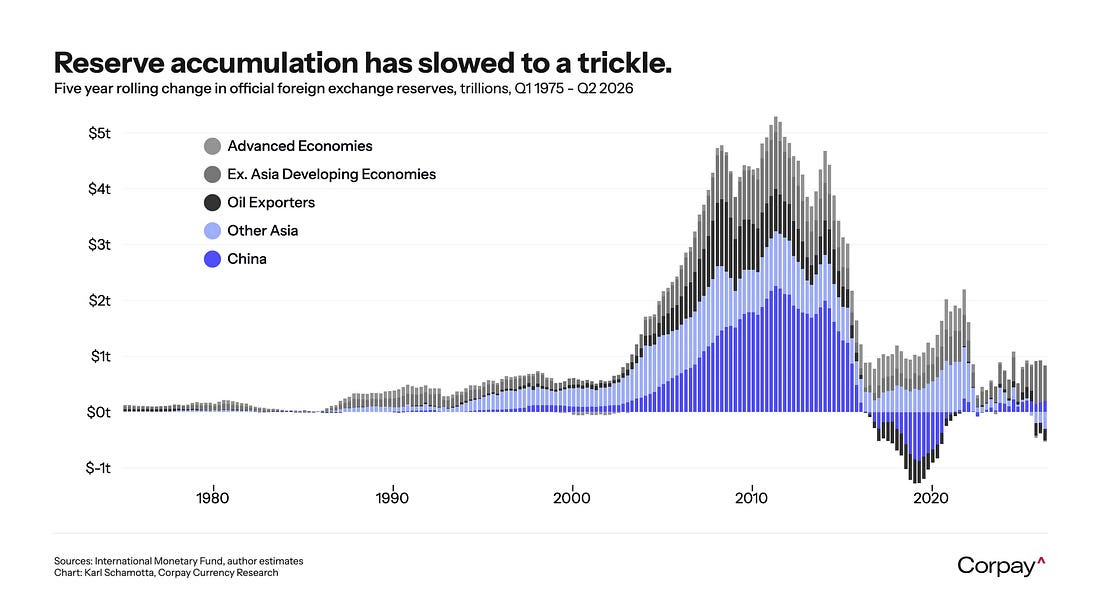
This week all the news services carried a story about the Dutch central bank shipping many, many tons of gold from the Mad King-led United States to the custody of cooler heads (well, cooling, we hope, after that very hot summer) in London.On the same day, the FT ran a story by Banu Baweja at UBS Investment Bank about how lots of people keep wanting to buy gold. Prices have eased a bit lately, but there is still plenty of demand, which they reckon will keep going. The Mad King and his only-slightly-less-mad Court are part of it, making the American finance products people generally use to try to balance out risk from other activity a bit suss.
But also, when the world cancelled foreign exchange reserves held by that other mad king in Russia, the UBS folk reckon people have started getting a bit suss on all money. "Reserve and asset managers globally were left confronting a simple question: if $630bn held in Treasuries, Bunds, gilts and other bonds could become inaccessible overnight, what constituted money?"
Apparently gold is the answer.
...In his Very Serious Treatise on Banking, Making Money, Terry Pratchett inserts this dialogue between our hero, Moist von Lipwig and the head of the bank/mint, Mr Bent:
"I read somewhere that the coin represents a promise to hand over a dollar's worth of gold," said Moist helpfully.Mr. Bent steepled his hands in front of his face and turned his eyes upwards, as though praying.
"In theory, yes," he said after a few moments. "I would prefer to say that it is a tacit understanding that we will honour our promise to exchange it for a dollar's worth of gold provided we are not, in point of fact, asked to."
...when Europe began to notice that the increased flow of US dollars into their region (mostly a result of paying military folk for the War in Vietnam), America was exploiting the central place the dollar had been given at the end of the Second World War. This breached the trust the world had in America's intention to use the dollar would to stabilise the global economy. This relied on the convertibility of the US dollar to gold. What with some Europeans threatening to ship their dollars to America and ask for the gold, thus breaching the implicit understanding that the promise to pay depended on not, in point of fact, asking for it, President Nixon solved the problem by ending the promise to pay.
This changed the relationships of all currencies to one another. Currency-by-currency stopped fixing their exchange rates to one another – the key to mid-century stability — and started allowing currencies to 'float' — values determined against other currencies by the market.
We've gotten very used to this, but the scale of the shock was significant. Buying components for the widgets you make (for example) was now complicated by changing exchange rates. Enterprises found that they were not only operating in a much larger and less stable world, but that to compete they also needed to be more agile in shifting their purchasing of things they needed to make widgets — components, human labour, energy sources — to wherever it was cheapest.
At first this was about finding the best deal on exchange rates, but it also turned into a global race to the bottom on labour costs (putting downward pressure on wages), warehouse costs (leading to 'just-in-time' production, destabilising employment), and corporate taxes, to try to lure the world's biggest business to your shores (leading to under-taxing capitalism and undermining the capacity of democracies to redistribute wealth in the interests of producing social stability out of an inherently unfair system).
In his book Offshoring, John Urry shows that these logics also encouraged the movement of money away from where it was made. The increased mobility of the type of globalisation that began in the 1970s was then accelerated in the 1980s when networked computers rapidly sped up the ability to trade in finance. Money was more mobile than humans, goods or indeed anything else.
In this environment, Urry argues, the super-rich were empowered to pursue a very successful kind of class warfare based on a combination of 'movement, relocation and concealment', pursing institutional changes (especially tax 'reform') that made whole 'offshore worlds' possible.
...Such offshoring of wealth was literal and metaphorical. Globalisation now made global the stage (or screen) on which life and major events were performed, 'transforming', said Urry, 'the character and temporality of life'.
Indra's Pool Andy Ilachinski
At the intersection of storytelling, aging, and higher education Bryan Alexander
How to Break Free from the Tyranny of Certainty: The Japanese Concept of "Ma" Marginalian
...despite all we know about the power of liminality and threshold states, we yearn for a firm foothold on one side of every blurry line and move through the fundamental mystery of life armored in opinions, mistaking the magnitude of our surety for the measure of the truth, resisting with every fiber of our being the fertile, flickering in-betweenness that beckons us to not-know in order to touch the beating heart of reality with something greater than understanding.Certainty is the dominant addiction of the modern mind.
quotes Ann Tashi Slater:
Ma means "interval" or "opening," both in space and time. Often referred to as negative (empty) space, it's positive in that it can birth something new. An invitation to heightened awareness, it's seen, for instance, as open space in rooms and gardens. With regard to time, it's a pause that invites contemplation. Ma is found in unpainted areas on folding screens, void areas in a photograph, silence during conversation, the hush between breaking waves. It's about the vitality generated by emptiness, in the way a blank page gives rise to creative energy. It's about being in relationship, because our engagement with ma allows fresh perspectives to emerge.
Stop Whatever You Are Doing and Record those Family Voices Alan Levine
9ix26
I'm Still Grieving the Future I Thought My Kids Would Have Angus Peterson at Medium
...while I'm pretty solid at understanding a manufacturer's manual to help troubleshoot my water softener, many people just aren't into that. So if using AI to assist with organizing maintenance records or helping to formulate questions before calling a professional, I don't think doing so makes a person a moral failure. Responsibility should reflect who controls the infrastructure and profits from its expansion, as well as how it gets used.That doesn't make individual use impact-free, and I can't honestly label everyone's usage a rounding error. It also doesn't make the output trustworthy. Check it against the actual manual and reliable sources. Electrical, refrigerant, gas, structural, roofing, and vehicle-safety work can exceed what you should attempt with generated instructions.
The useful skill is being able to learn from a tool while recognizing when its confident answer needs checking.
Cory Doctorow
...As many people have observed, the problem with vaccines is that they work too well. The incredible, astounding, profound wonders of vaccines led many people to think of measles as a rash, the flu as a bad cold, mumps as a thing that makes you look like Brando playing Don Corleone. Vaccines worked so well to eliminate a terror that stalked the land and stole people's lives and loved ones and little children, an achy arm or an infinitesimal chance of a few days of feeling like shit seemed worse by comparison
Adding Injury to Insult, Canada Edition Paul Krugman
8 Interesting Books I have Read Recently Scott H Young at Medium
...There was only one catch and that was Catch-22, which specified that a concern for one's own safety in the face of dangers that were real and immediate was the process of a rational mind. Orr was crazy and could be grounded. All he had to do was ask; and as soon as he did, he would no longer be crazy and would have to fly more missions. Orr would be crazy to fly more missions and sane if he didn't, but if he was sane he had to fly them. If he flew them he was crazy and didn't have to; but if he didn't want to he was sane and had to. Yossarian was moved very deeply by the absolute simplicity of this clause of Catch-22 and let out a respectful whistle.
Intimate Glimpses of Time: Four Photographs Don Giannatti at Medium
The danger of viewing the cosmos as a mirror that shows us ourselves at New Scientist
...we can appreciate the wonder of the cosmos without inserting ourselves as a main character...we often hear that we are carbon-based life forms. Carbon exists in the cosmos because compact balls of hydrogen heated up and became dense enough for nuclear fusion to begin. Which is to say, stars formed, and carbon is a by-product of a star. "The cosmos is within us. We are made of star stuff," the astronomer Carl Sagan famously said.
...In a system that trains us to extract value for ourselves from the cosmos, we forget that its beauty can be its own justification. That the sense of connection it generates between us might be enough
Flock Wants a Closely Surveilled World with No Exit New Yorker
The company, which has a hundred and thirty thousand cameras monitoring the streets of the U.S., frames privacy as a worthwhile trade-off for safety and security, echoing the language of the post-9/11 surveillance boom.Garrett Langley, the founder of Flock Safety, frames surveillance as a Faustian bargain. If we want to live in a world where "crime is unsustainable" and "a thing of the past," in his words, then we must "sacrifice our privacy." Imagine: no more carjackings or kidnappings, murders or robberies, rapes or vandalism. "Everyone, in my opinion, deserves the right to be safe," Langley said, during a TED talk last month. "It should not matter the color of your skin, your political affiliation, or your income level."
...Flock was recently reported to have a valuation of more than eight billion dollars, with its biggest investor being the venture-capital firm Andreessen Horowitz. Around forty per cent of the United States' law-enforcement agencies now have contracts with the company, and a reported hundred and thirty thousand cameras monitor roads in every state but Alaska. Flock cameras have evolved from their initial prototype, and now read more than just license plates: they record the make, model, and color of passing vehicles, data that are then controlled by whatever entity operates the camera. Police can use this information, without obtaining a warrant or judicial approval, to make arrests or to present as evidence in court.
...Trade-off, security, safety—this was the language of the post-9/11 surveillance boom, and, lucky us, it never left. The journalist Richard Beck, in his book Homeland: The War on Terror in American Life, from 2024, summarizes the ends to which the fear of terrorism drove an unimpeded and irreversible increase in mass surveillance within the U.S. When the Patriot Act was introduced to Congress, a month after 9/11, a "remarkable spirit of bipartisan unity" allowed for "the biggest expansion of law enforcement detention and surveillance powers in history."
...Mass surveillance can be difficult to comprehend or think plainly about, ensconced as we are in the digital cocoon of contemporary life. How are we to understand the scope, nature, and threat of systems we cannot see or touch? When we use social media, or accept online privacy-policy updates and agreements, it can be unclear how, exactly, we are being violated. Are we not consenting to these services? Are we not uploading images of ourselves and freely conversing with friends and colleagues, knowing the potential risks of being tracked by our government and tech overlords? How are we to engage with these digital platforms without feeling paranoid, or dissociating from the fact that we are potentially being watched by law-enforcement agencies and large corporations? Zuboff, in her book, described this quandary as "a psychic numbing that inures us to the realities of being tracked, parsed, mined, and codified." In other words, we must convince ourselves that the digital communication and information systems we use are harmless and, indeed, beneficial, in order to keep using them. Opting out of online life has become nearly impossible given how crucial these tools have become in many professional, academic, and personal contexts. We've accepted the compromises of the internet mostly out of submission; there is no visible or viable path for existing in the modern world without in some way resigning ourselves to the realities of surveillance.
..."The motivations behind Silicon Valley's pursuit of mass surveillance and bulk data collection don't need investigating," he writes. "They did it for the money." As private equity continues to pour resources into Flock, and as its cameras multiply across the country, questions will persist about how much compromise, sacrifice, and trade-off we can withstand before nothing is left of us to give away.
Can You Write a Memoir in the Third Person? Hua Hsu at The New Yorker (on Brian Dillon's Ambivalence: An Education
...Memoirs rely on a balance of the singular and the universal. We are curious about the idiosyncrasies of another's life, but they can't be so idiosyncratic that the reader finds their passions or motives wholly unrelatable. The all-knowing first person can suggest that a memoirist has already made sense of everything before sitting down to write: all the details and detours have been assimilated into a single, overarching story. Yet this isn't how life feels in the moment, and Dillon attempts to capture the texture of a stretch of youth where nothing seems to be happening quickly enough.
Bruce Sterlin's futurist cinema lots of thumbnail videos
Iran War: Tehran's assertive Rhetoric signals a new and dangerous Phase in Conflict Informed Comment
The Return of Ancient History Jon Wilson at Informed Comment
...today, anxious leaders across the world are turning to ancient history. Vladimir Putin invaded Ukraine while lecturing Tucker Carlson for two hours about ninth-century Novgorod and a Viking prince named Rurik. Narendra Modi consecrated a grand new temple to Ram at Ayodhya in 2024, presenting today's India as an unbroken Hindu civilization rather than a secular republic created in 1950. China's rulers trace their state's origins to centuries of apparently unbroken unity, rather than communist revolution. Nigel Farage's Reform UK and countless fellow-travellers evoke the ancient unity of England and the more recent history of empire to justify their opposition to European intervention and immigration.None of these stories is exactly made up. But they are profoundly misleading, treating the nation-state as an ancient inheritance finally reclaimed. In fact it is one of history's newest, and most improbable, political inventions.
In 1914 and again in1945, few imagined the world would be organised into nation states. Between these years, war and economic crisis caused near-total global collapse. Empires crumbled and hundreds of millions were killed or displaced. In this three-decade rolling global catastrophe, multiple different ways of organising political power were put into practice, with the nation state far down the list. Federation was one popular option, with the Soviet Union's model of multiple nationalities in a single state an example even for many liberals.
...A world of formally sovereign, juridically equal nation states allowed enough flexibility to hold incompatible visions of the future at once. It did so by committing everyone to remarkably little in substance — not to a particular definition of democracy, nor to a specific economic system, only to the bare principle that a recognised people should govern a recognised territory without outside interference.
That emptiness was the point. Communists could fill it with central planning, Americans with free markets, anti-imperial nationalists with a long-deferred promise of self-determination finally redeemed, former imperial powers with a face-saving way to withdraw without admitting defeat. The nation state won because it was the one form every rival could tolerate in someone else's hands.
This is what today's nationalists misunderstand. They, together with their anti-national globalist opponents, are trapped in bad history, claiming there is some authentic, original way of organising the world waiting to be recovered.
Preserving a Precious Library of Southeast Asia Ann-Ruth Wetheim at Informed Comment
My father Wim F. Wertheim (1907-1998), a professor of South-East Asian sociology and history, had a library of some four thousand books. When in the final years of his life we children asked him what should be done with it after he died, he always replied that it was entirely up to us. He believed that you should not burden your surviving relatives with tasks whose weight you cannot properly assess. We then just thought we would see when the time came, for even if he was old there was nothing wrong with him, and he was still writing articles and letters to newspapers, and even a book.But when the time did come in 1998, we faced awkward questions. Would we try to keep the whole library in one piece? After all, the combination of books said so much about him, his way of thinking, the things that mattered to him, and his affinity with the peoples of South-East Asia, especially Indonesia. It also said so much about his approach, and how year after year he had bought the books of relevance to his research at the time.
Subject Relations: Merve Emre, Anna Silman NYRB
...Sometimes a person is just clearly interesting; other times, they occupy an interesting space in the culture that is emblematic of a time or social shifts. I profiled a woman named Marissa Ross, who was a wine critic and part of the early wave of food social media. She dealt with a lot of online harassment. She has a big personality, and has been through many phases of her career. She was also an emblematic figure of early Instagram, when people were really self-promotional, and only later realized what a psychological toll it took. I felt like not only was she interesting, but by profiling her, I could touch on bigger questions about what it means to be a woman online....Interviewing celebrities can be a slog, because they have prepared talking points. Their work may be interesting, but they themselves aren't that interesting. I always prefer to interview someone who isn't likely to have canned responses prepared.
Fathomless Becoming Andy Ilachinski
quotes Walt Whitman:...I perceive I have not really understood any thing,
not a single object, and that no man ever can,
Nature here in sight of the sea taking advantage of me
to dart upon me and sting me,
Because I have dared to open my mouth to sing at all.
...New technologies often create good conditions for middlemen. In the 1960s entrepreneurs snapped up mainframes from IBM and leased them to banks and defence companies. In the dotcom era “domainers” bought website addresses and sold them at a higher price. Artificial intelligence is no different. Consider the neoclouds, such as CoreWeave, which buy specialist AI chips and rent them out. They are among the fastest-growing companies in the AI industry. But they are also some of the most vulnerable. Neoclouds have thrived over the past few years, for two reasons. The first is that demand for AI has grown more quickly than America's "hyperscalers" have been able to expand their computing capacity. Many neoclouds started off as crypto miners, and subsequently repurposed their data centres. And because they have focused exclusively on AI, rather than a broader range of cloud services, they have been able to concentrate their investments. As a result, their biggest customers are model-makers, such as OpenAI, and the hyperscalers themselves, who often lease extra capacity from the neoclouds. The second reason for their rise is that Nvidia, the leading maker of AI chips, which is eager to reduce its reliance on the hyperscalers' custom, has provided various forms of financial support to help them buy more of its chips. The combined annual revenue of the five largest listed neoclouds—CoreWeave, Nebius, IREN, Applied Digital and Core Scientific—has risen to $18bn over the past 12 months, up from $3bn in 2024. Although they are still far behind the hyperscalers, they are gaining ground. Dell Oro, a research firm, estimates that in total neoclouds have 1.5-2.5 gigawatts (GW) of data-centre capacity between them, compared with a combined 20-24GW for Alphabet, Amazon, Microsoft and Meta. But they are roughly doubling their capacity each year, which is about triple the rate that the hyperscalers are managing....That growth, however, is being funded by mountains of debt. The five listed neoclouds now have $61bn-worth of borrowing on their balance-sheets, quadruple the amount just 12 months ago, as well as $18bn-worth of operating leases (see chart). None is generating an operating profit, and all are deeply in the red once interest bills are added. In the most recent quarter Nebius's interest payments amounted to a fifth of its revenue; CoreWeave's reached a quarter. The neoclouds are betting that, if they continue their vertiginous growth, profits will eventually arrive. Perhaps. But the competition has shown no sign of easing. Besides the established cloud giants—as well as Meta, which is considering launching its own third-party service—there are now some 200 neoclouds around the world duking it out for contracts. Add to that a growing cohort of mid-sized providers. Oracle, originally a database company, has spent a fortune trying to join the hyperscalers' club with a cloud business of its own. Its capital expenditure, much of which is financed by borrowing, is expected to hit $77bn this year. In July SoftBank, a Japanese conglomerate up to its eyeballs in debt, unveiled a cloud business called SB Neo. The group also owns a majority stake in SB Energy, an infrastructure business that has teamed up with OpenAI to build a giant data centre in Ohio, and which filed on September 1st for an initial public offering. Fierce rivalry compounds the two big risks facing neoclouds. The first is a credit-market shock that pushes borrowing costs higher, further squeezing margins. Investors already seem jittery: the spread in yields between neoclouds' bonds and junk bonds as a whole is widening. A second—and even bigger—danger is that supply and demand rebalance. Right now, vast amounts of infrastructure are being built on the assumption that use of the technology will continue to soar. If the pace of adoption slows, however, model-makers and hyperscalers alike may quickly decide they no longer need the neoclouds.
Source: The Economist
Archaeologists Just Found the Most Complete Denisovan Record Yet—and It Goes Back 190,000 Years gizmodo
What Is Math's Mysterious Langlands Program Really About? Quanta Magazine
The mathematical universe is boundless and heterogeneous, encompassing, over here, truths about numbers and equations; there, the logic of shapes and spaces; and over there, the study of change and probability. Its domains have grown organically over centuries, each centered around its own objects, methods, and questions. That's why it's so surprising when direct connections between different areas of math are discovered, like wormholes linking distant galaxies.
A NASA Photo Processing Technique to Study Mars Has Discovered Ancient Art on Earth PetaPixel
...decorrelation stretch.... "Rather than simply raising the contrast between colors, decorrelation stretch maps the original colors to a different, expanded range of colors. It's a complicated process that includes steps like diagonalizing color matrices," NASA says
Sci-fi is starting to exploit the infectious horrors of memes Sally Adee at New Scientist (6iv22)
A new micro-genre of science fiction explores how mind control is at the very heart of our networked existence...Memes are, of course, ideas that lend themselves to jumping from one brain to another. Like that trick where someone tells you not to think about an elephant, once the image has made its way into your mind, you can't stop the chain of events that unfolds. Richard Dawkins coined the term meme for the phenomenon in 1976, back when it was a relatively unproblematic aspect of how units of culture are transmitted through society. But in our hyper-networked world, memetic spread has become uncontrolled and uncontrollable, and there is something a little unsettling about it. From the QAnon conspiracy theory to the cheezburger cat, there is no telling what will show up in your feed or who produced it. Whether you consent or not, it will nestle between the folds of your brain and start to lay its eggs.
This sinister process is well established in neuroscience: where our expectations lead, our perceptions of reality follow. Memes can set those expectations, distorting and warping them with someone else's narrative. Sometimes, these are harmless, like the dress that seems to be both blue and white or the audio version, yanny/laurel. Other times, they are more sinister, like the kissing men who may or may not be cannibals, or a conspiracy theory that a pizza restaurant had paedophiles in its basement. Memes can even distort what is right in front of your face.
While the events of Devlin's book are horrifically plausible, in There is No Antimemetics Division by Sam Hughes (also known by the pseudonym qntm), perceptual expectations are managed by some of the creepiest supernatural beings imaginable. As they lurk unseen by almost everyone, they wreak havoc on an unsuspecting public, who make sense of things by inventing narratives to explain the horrors around them. An entity that creeps around collecting fingers, for example, is explained away as an unusually high rate of kitchen and carpentry accidents.
Hypocrisy, hypercrisy, and standing to blame Philosophical Studies
Other-serving double standards: People show moral hypercrisy in close relationships Alexa Weissa and Pascal Burgmer (pdf)
Mung beans
Cholesterol-Lowering and Liver-Protective Effects of Cooked and Germinated Mung Beans (Vigna radiata L.) NIHHypolipidemic and Hypoglycemic Effects of Mung Bean in the Experimental Model: A Systematic Review Divya Gupta1 and Vandana Verma
Mung Beans: The Superfood Bean You're Probably Missing Out On
Andy Ilachinski
10ix26
New York's 1.67 Million Buildings Colored by Age maps mania
Hot, Hotter, Hottest: The President from (Literally) Hell Tom Engelhardt
Consider climate change, in fact, a potential global disaster that deserves a far more horrifying name. And consider it just the latest form of (in)human warfare to come to our attention, this time against the planet itself as a livable place for us. And consider it as well no small thing that we humans have indeed produced a second way to essentially destroy this planet and ourselves.
How to Change Your Life Marginalian
Canada's Heroic Delusion Dónal Gill at Dial
11ix26
Unconstrained and unencumbered Christopher Hobson
Zooming out from any specific conflict or case, 'degenerative volatility' is a good way of describing these more generalised conditions:
We are living through a period in which instability is no longer episodic but structural. Energy systems are strained, ecological boundaries are tightening, fiscal buffers are thinning, supply chains are reconfiguring under geopolitical tension, and informational environments are fragmenting. These pressures do not arrive one at a time. They compound. The result is not ordinary volatility but degenerative volatility: a condition in which shocks are chronic, mutually reinforcing, and increasingly expensive to absorb.
...Let me guarantee you one thing: someday, when it comes to the overheating of this world of ours, he will be seen as an almost unparalleled idiot, assuming that anybody then is seeing much of anything.
Don't try to wash
your tired hands
clean from the bloodshed
of your private wars.
Just unclench the fist
that has come to feel like home
and let the story slip
between your trembling fingers
into the river of time,
silver and indifferent....Turner labored under that "heroic delusion" that Canada could be fully sovereign from the U.S., sustained by the civic virtues of federalism, bilingualism and multiculturalism. Like all national narratives, at its best this is little more than a persuasive fiction
...René Girard's depiction in Battling to the End:
We continue to think about the acceleration of contemporary conflicts as if they followed the same rules of logic as they did in the past. People still use the rationalist reading of Clausewitz, with its refusal to see the immanence of the duel. Today we are heading toward a form of war so radical that it is impossible to talk about it without making it sound hyper-tragic or hyper-comical, so unlimited that it can no longer be taken seriously.
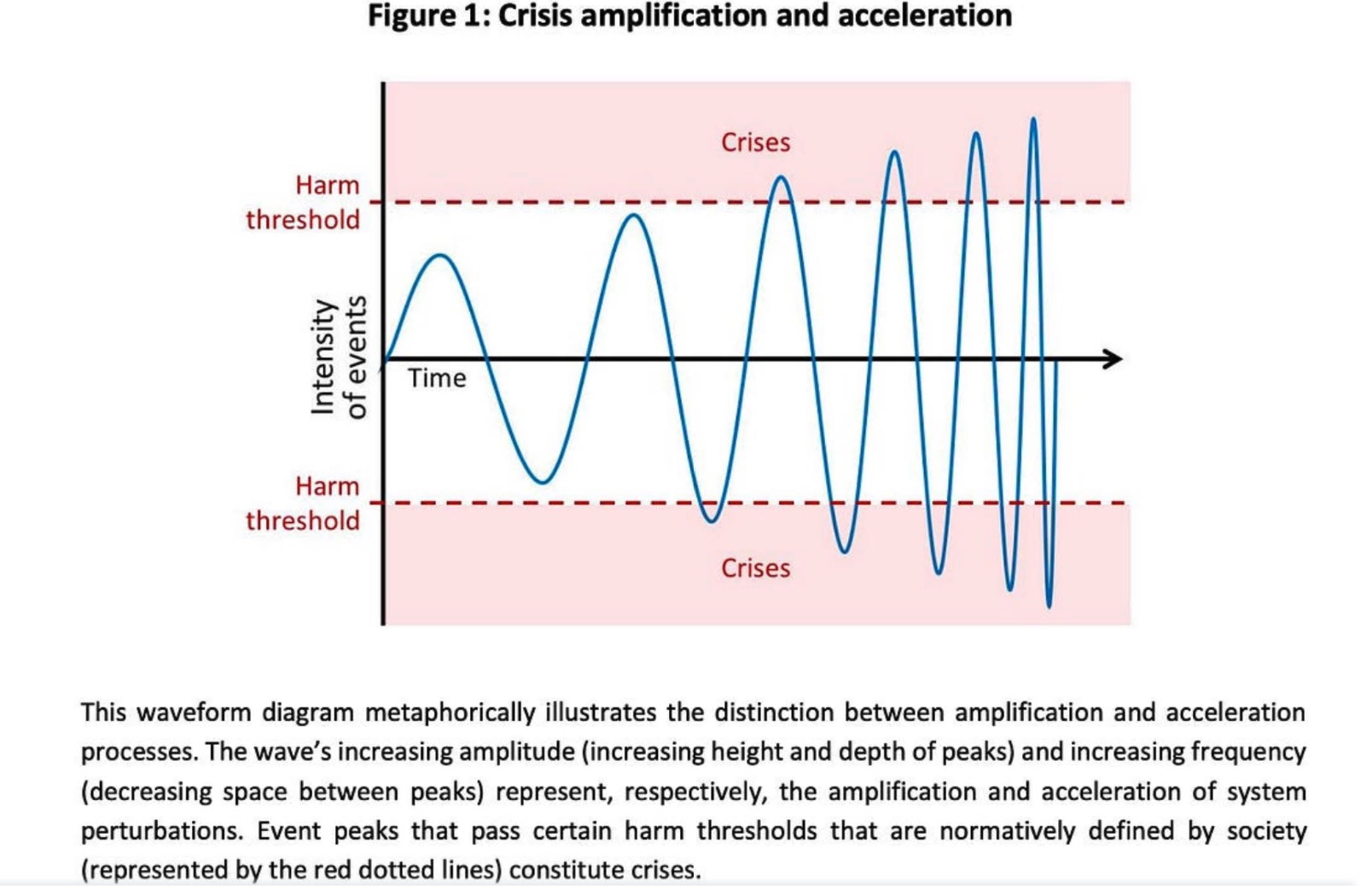
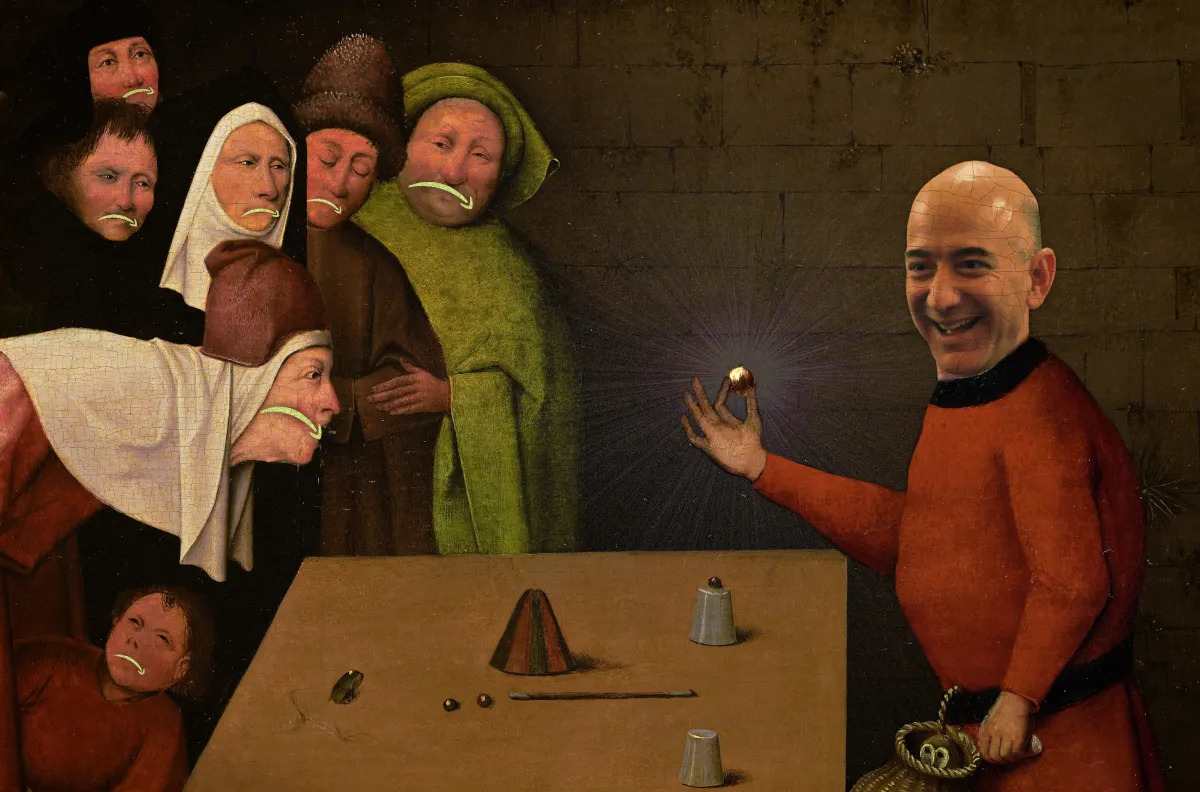
Amazon's own balance sheet presents the most compelling evidence that we are stuck in the Enshittocene, the era in which everything is turning into a pile of shit, because the worst ideas of the worst people now make the most money.Amazon is a many-tentacled monster, with several prominent lines of business wrapped around the world. There's its logistics and fulfillment business, which is so successful (at the expense of its workers' labor rights, bodies and bathroom breaks) that it is more than fully subsidized by Amazon's platform sellers, the independent merchants who depend on Amazon to sell and deliver their goods.
This means that it costs Amazon itself nothing to get the merchandise it sells to your door: more than 100% of the cost of operating the fulfillment side of Amazon is covered by the fees it extracts from its independent sellers (who compete with Amazon in many instances, and for whom delivery is a cost center, not a source of profit).
Then there's AWS, Amazon's cloud business. This is another extraordinary success story: every company needs servers, and that's especially true of an e-commerce company like Amazon. By building more servers than it needs, Amazon transformed its own data infrastructure from a cost center into another profit center. Amazon's customers — many of whom are also its competitors — pay Amazon so much to rent space on its servers that Amazon gets its own (prodigious) computing for free, and realizes a profit on top of that.
Taken on their own, these two facts constitute an extraordinary business story: one of the largest corporations in the history of the world has converted its two largest cost centers into profit centers, and those profits are substantially generated by extracting payments from the company's own competitors!
...Amazon's payola isn't about radio play — it's about search. When you search Amazon, the top results do not represent Amazon's best guess about what product will best match your query: rather, Amazon auctions off those top results to its platform sellers. Amazon's search results reflect who paid the biggest bribe, not who has the best product.
To pay for those bribes, platform sellers have to raise prices. Amazon helps them do this, by imposing a "most favored nation" clause on its sellers that requires them to sell on Amazon at a price that matches or beats the price charged everywhere else (Target, Walmart, a mom-n-pop, or the factory store):
https://pluralistic.net/2026/02/25/most-favored-nation/#price-fixing
Thus, Amazon imposes an economy-wide tax on nearly every product you buy. Amazon's junk fees average 51-60% of the purchase price of the things you buy there, and because Amazon has captured a supermajority of the richest 10% of Americans (who have almost all pre-paid for a year's shipping through Prime), every seller must sell on Amazon, or forego any hope of selling to most of the country's most prolific shoppers.
...AI has made Amazon much better at enforcing Most Favored Nation terms, because AI is actually pretty good at parsing competitors' websites and finding instances of discounting, which Amazon instantaneously punishes by relegating the sellers' product listings to page umpty-billion of Amazon's search results.
Let me remind you: payola is Amazon's single largest source of profits. When I was researching Enshittification, Amazon's take from payola was in the mid-$30 billion. A year later, when I did tour stops with Tim Wu (who was promoting his excellent book The Age of Extraction), I learned that this number had climbed to more than $50 billion. This year, it's on track to top $80 billion.
Amazon calls this bribery system an "advertising" product, but it's not "advertising" in the sense of the ads that Amazon's platform sellers might have once placed in the local newspaper. It's payola, more akin to the practice of packaged goods companies buying end-caps and whole shelves in the grocery store (a practice that is, in its own way, every bit as corrosive, though no grocery store has Amazon's economy-wide chokehold)
...As Tim Wu points out, the money Amazon makes from payola exceeds the advertising revenue received by all the newspapers in the world by 300%. Alongside that number and its implication for the news media, Jeff Bezos buying the Washington Post and turning its editorial page into a sewer of shitty Ayn Rand fanfic barely registers.
This is pure enshittification. Of all the ingenious, innovative ways that Amazon came up with to make money, the most successful is a scam that makes everything you buy more expensive even as it reduces the profits of the companies you're buying from. It's another example of corruption: a system of concentrated gains and diffuse losses — and once again, it's the most profitable thing Amazon does.
And then... Amazon made it worse.
You know how people like to say, "If you're not paying for the product, you're the product?" It's bullshit. The "advertisers" who bribe Amazon for top search placement are the customers here, they're "paying for the product," and they are getting reamed. I don't just mean they're getting screwed by being forced to shell out payola — I mean that Amazon is cheating them on that payola!
Remember: Amazon doesn't just sell search placement; they auction it. Every time you run an Amazon search, the company conducts a special kind of auction called a "sealed-bid second-price auction" (SBSPA)
Yes, the Apple Watch's New Audio Intelligence Features Really Are Always Listening to You lifehacker
Researchers found evidence of drug use 25,000 years ago boing boing
...according to Nature, "betel nut chewing is closely associated with a variety of health hazards, including oral cancer, cardiovascular diseases, and metabolic syndrome."
12ix26
The Unspeakable World: Alan Watts on How to Touch the Pulse of Life Marginalian
...What makes life so disorienting is that its greatest revelations and greatest transformations are inarticulable. William James knew this when he listed ineffability as the first of the four features of transcendent experiences. Everything beautiful and meaningful, from the grand elations to the small gladnesses that make life worth living, is irreducible to words, is sand slipping through the fingers of language as we try to capture it.
Henry Farrell and Abe Newman on Weaponized Interdependence Paul Krugman
...…after 9/11, different U.S. bureaucracies start to see these places in the international system where they can either exclude actors, like with SWIFT—say you can't have access—or they use it to monitor, to surveil. We call it the Panopticon. And that's what you see in the Snowden revelations. And so it's both the development of markets, that markets are centralizing around U.S. companies and products, and then also that the U.S. government has this legal jurisdiction over them. Farrell: And the final thing to add to that is just that there's also an institutional change that happens as well. And this is really connected with September 11th, 2001, because before that, you know, SWIFT manages to push back relatively successfully against U.S. efforts to try and get into its data. Mueller and other people—of course, Mueller is famous for his efforts to try and figure out what Donald Trump did, but at the time, he was in the FBI. And so he tries to get SWIFT to provide information, sort of via subpoena, and SWIFT's response, crudely speaking, was, "We don't do subpoenas." And they are able to call on their friends in the U.S. Treasury, and Treasury sees part of its job at the time as being protecting the global financial system against the depredations of the United States national security state. And then suddenly, after September 11th, that is completely reversed. Treasury radically revises its understanding of its self-interest as being—instead of trying to protect the global financial system—it begins to start looking at the global financial system, thinking, "What are the ways in which we can enhance U.S. power to defend against these actors, these terrorists?" And over time, as happens in every bureaucracy, this begins to creep. It begins to expand until the U.S. is willing to go after lots and lots of different actors, including, most recently under Trump, officials in the International Criminal Court....there's a lot of improvisation. And the final thing I would say is that, if we look at the world of weaponization, as you say, there seem to be choke points everywhere. And also there are all sorts of ways in which the choke points are connected to parts of the economy where things can go very badly wrong. So you can think about this as being a complex system, and the standard way that people think about the world and complex systems is that if you do stuff, sometimes unexpected stuff happens. And the more that we see actors looking to weaponize without any very good maps of how and what they are doing or what kinds of unexpected repercussions might happen, the more we can expect not simply increased risks of tension and worry, but also people screwing up, doing dumb stuff.
...more that we're in this world, the more that we find ourselves in a world where really unexpected things can happen, and where policymakers don't have the strategic knowledge, and they also don't have the sense of how the system works, that would really allow us to create the kinds of stability that, for example, businesses and ordinary citizens who want to live their lives without having to pay whatever ridiculous amount it is for diesel... You know, that is a world that is very far away from us right at the moment.
...we've moved from a kind of Thomas Friedman "the world is flat," "everything is awesome" kind of view in which we completely cut out all of the geopolitics—we think politics is irrelevant because nobody would go to war against another country if they also have McDonald's, and all of these theories—into a world where, I think, pretty well the opposite is happening. So we have these sort of policymakers now, squirrely-eyed, looking at the world, looking at every sort of possible external dependency as if it's a massive threat.
...There's a great piece by Guillaume Beaumier where he basically says, "Look, in the semiconductor supply chain, there's multiple choke points, there's multiple networks. It's not like there's just one set of these networks." And actors control different pieces. So ASML, the Dutch company that makes the lithography, the etching systems—they sit in the Netherlands, whereas the software part is in the United States, and of course the production is in Taiwan. So who has the advantage? And that's where really policymakers in our world focus less on these choke points and more on how do you manage a world where there are these interdependencies?
SubTuringBradBot & Parasocial Sociability: SUNDAY SPECIAL: MAMLMS & SOCIETY Brad DeLong
Starting around the year -3000, with the coming of writing, humanity cognition ceased to be a band-limited lifespan-limited anthology intelligence of those who spoke face-to-face, and become something more. Human memory and cognition could then span the entire world, anywhere a written message could be carried and read, and all of time forward as long as what had been written was preserved and recopied. That produced what I call the real ASI: the real Anthology Super-Intelligence. The real ASI is not some ASI that is the Artificial Super-Intelligence from some grifter dreaming of a fortune or some self-grifter TechBro deluded and high on his own supply. The real ASI is the now-5000 year old global-scale Anthology Super-Intelligence of the collective human mind since Uruk.The modes and scale of that real ASI has undergone superinflationary growth at several moments in the past 5000 years. One was in the aftermath of Gutenberg in the mid-1400s. And another is ongoing today.
...The individual human intellect stopped being bounded by the people it could physically reach and the few texts it could physically touch, and became a node wired into the accumulated, externalized, copyable memory of the species. I call this the real ASI, the Anthology Super-Intelligence of the collective human mind: Machiavelli's relationship to his books is the first moment at which we can see clearly. His personal library is not a storehouse he consults. It is a set of colleagues he collaborates with. He asks; they answer
...What is happening now is an extension of the Machiavellian Singularity, not a rival to it: a faster index, a more fluent and more tireless interlocutor sitting on top of the exact same accumulated textual inheritance that print created and that print made cheap. The break already happened. We have been living on the far side of it for five hundred years.
culanth.org (my Faith Restored)
Lexicon for an Anthropocene Yet Unseen...Photosynthesis is my keyword for this era that we keep calling the Anthropocene. Photosynthesis circumscribes a complex suite of electrochemical processes that spark energy gradients across densely folded membranes inside the symbiotic chloroplasts of green beings (Margulis and Sagan 2000). Textbook diagrams familiar from high-school biology class are simplistic renderings of that utterly magical, totally cosmic alchemical process that tethers earthly plant life in reverent, rhythmic attention to the earth's solar source. The photosynthetic ones—those green beings we have come to know as cyanobacteria, algae, and plants—are sun worshippers and worldly conjurers. Lapping up sunlight, inhaling carbon dioxide, drinking in water, and releasing oxygen, they literally make the world. Pulling matter out of thin air, they teach us the most nuanced lessons about mattering and what really matters: their beings and doings have enormous planetary consequences.Dissonant Ecotones, Fractured Strata: Histories of Environmental Anthropology
Graphic Ethnography on the Rise
An Anthropogenic Table of Elements
Keywords for Ethnography and Design
13ix26
Have the US, Israel and Saudis lost the Battle of the Narrows? Juan Cole
...Portugal's monopoly on pepper was broken by 1550, Fernand Braudel argued, because the Ottomans dominated the Red Sea and defeated Portuguese attempts to blockade the Bab al-Mandeb at its mouth, and opened the Red Sea route to Venetian merchants. Since Asian pepper could reach Venice more cheaply and more quickly via the Red Sea than via West Africa, Portugal's monopoly faced steep competition.
2026's El Niño will be More Severe than any ever Recorded, affecting global Shipping, Fish Behavior and Heat Informed Comment
...El Niño is a naturally occurring phenomenon that can affect weather around the world. Its origin lies in the tropical belt of the Pacific Ocean.Normally, trade winds along the equator blow from east to west in this region, pushing warm surface water toward the islands of southeast Asia, where it accumulates.
The first sign that El Niño is developing is a weakening, or even reversal, of the tropical Pacific trade winds. Without the winds, warm water in the east begins to flow back and eventually occupies much of the equatorial waters down to about 300 meters from the coast of South America to the middle of the Pacific.
That shift sets off a chain of changes in weather patterns around the world.
...The Panama Canal is one of the world's most important shipping choke points, particularly for ships traveling to and from the U.S. It relies exclusively on fresh water from rivers pouring into Lake Gatun to operate its system of locks, which act like elevators — filling with water to lift each ship 85 feet (26 meters) from sea level to the lake and then back down to sea level on the other side. The canal saves days of travel time and hundreds of thousands of dollars in fuel costs as ships travel between the Atlantic and Pacific oceans. Panama is normally so rainy that the locks can function at full capacity throughout the year. During droughts, however, the lake levels can begin to fall even during the rainy season when they should be going up. Once lake levels are no longer safe for the largest ships to pass, the Panama Canal Authority, the agency in charge of the canal, begins to restrict their maximum draft, meaning how deep into the water the ships sink when loaded. Even before then, it starts to reduce the number of ships that can pass each day in order to save water.
14ix26
Nichomachean Ethics Wikipedia
The Same Afternoon Kennedy Was Shot, Aldous Huxley Asked His Wife for One Last Dose of LSD H. Willraft at Medium
Natural feedbacks will warm world an extra 20 per cent this century New Scientist
Techne Wikipedia
Episteme and Techne Stanford Encyclopedia of Philosophy
Npus Wikipedia
The MAGA Plot(s) to Destroy Humanity Paul Krugman
...everything we know about climate change suggests that what we've seen so far is just a foretaste of the disasters to come. Yet last year, speaking at the United Nations, Trump dismissed climate change as a "con job," while calling renewable energy sources such as solar and wind — which met almost all of the world's growth in electricity demand last year — a "scam." And this disdain is being reflected in policy. As I and many others have written, the Trump administration has been actively trying to block wind and solar power projects. And today the administration is reportedly planning to eliminate all restrictions on greenhouse gas emissions from power plants. There is a lot to be said about the reasons our current government seems so determined to rush into disaster, even when the very survival of humanity may be at stake. Climate denial, we know from decades of experience, is fueled by an unholy trinity of financial interest (fossil fuel companies determined to keep their profits flowing), ideology (conservatives hostile to any form of regulation) and psychological insecurity (real men burn stuff.) AI-risk denial presumably reflects a similar mix of factors. So let's applaud leaders like Amodei for speaking up and applaud the growing willingness of other CEOs to warn about the dangers of their technology, even if their attack of conscience partly reflects the looming prospect of Democratic subpoenas.
'Flower' in Austronesian languages
Historical names of Ancient Egyptian/Pharaonic cities and their Greek and Arabic equivalents
Mike Caulfield
Gastrodome: O Is For Octopus Timothy Burke
...Octopus wasn't like squid, though squid pretty much opened the door for octopus via calamari. Calamari let people eat squid who wouldn't eat squid, if you know what I mean—deep-fried rings of squid that didn't look squid like made it safe to indulge. You could throw away the tentacles or leave them for the person who liked them. But octopus is almost all tentacle. You can't escape that by breading them. There's no hiding what you're eating. So octopus came inside along with its cephalopodic buddy but it retain its viscerality for some eaters.
That's probably the only thing keeping octopus from really being driven into fully unsustainable overfishing. So, yeah, if you think octopus seems disgusting, take it from me, it is. Really. Don't try it.
Scientists Warn This Year's El Niño Could Create Brand New Extreme Weather Patterns gizmodo
15ix26
The Biggest Map of Roman Roads Ever Made Still Isn't Big Enough gizmodo
16ix26
Iran's Threat to cut undersea cables in Hormuz a serious Threat to Gulf States Informed Comment
These cables form a largely unseen foundation of the global economy, carrying more than 95% of international data traffic. Their role extends far beyond everyday internet and call usage. They support financial transactions, government communications and the increasingly data-intensive operations of the global technology sector.
Major technology companies such as Google, Amazon, Meta and Microsoft are investing heavily in subsea connectivity as they expand data-centre networks and seek to meet the growing demands of AI. For the Gulf States, where hundreds of billions of dollars are being invested in AI as part of efforts to diversify economies away from fossil fuels, disruption to this infrastructure could therefore have consequences far beyond communications. Cutting these CUI cables threatens a key element of their broader economic ambitions.
Paddy Keenan 1950-2026
Slang and its analogues past and present A dictionary, historical and comparative of the heterodox speech of all classes of society for more than three hundred years....Most octopus species are very short-lived (one of the reasons that their relative level of intelligence is so interesting and puzzling) and they are r-selection, meaning they produce huge numbers of eggs. So at least some octopi species can be sustainably fished if there's some regulation of the industry. In the world of 2026, that's a big if, unfortunately.
...On August 16, the Wall Street Journal reported that the Iranian government was considering attacks on that network. In the Gulf's relatively shallow waters, threats to this critical undersea infrastructure (CUI) pose a credible risk to the Gulf States and the wider world.
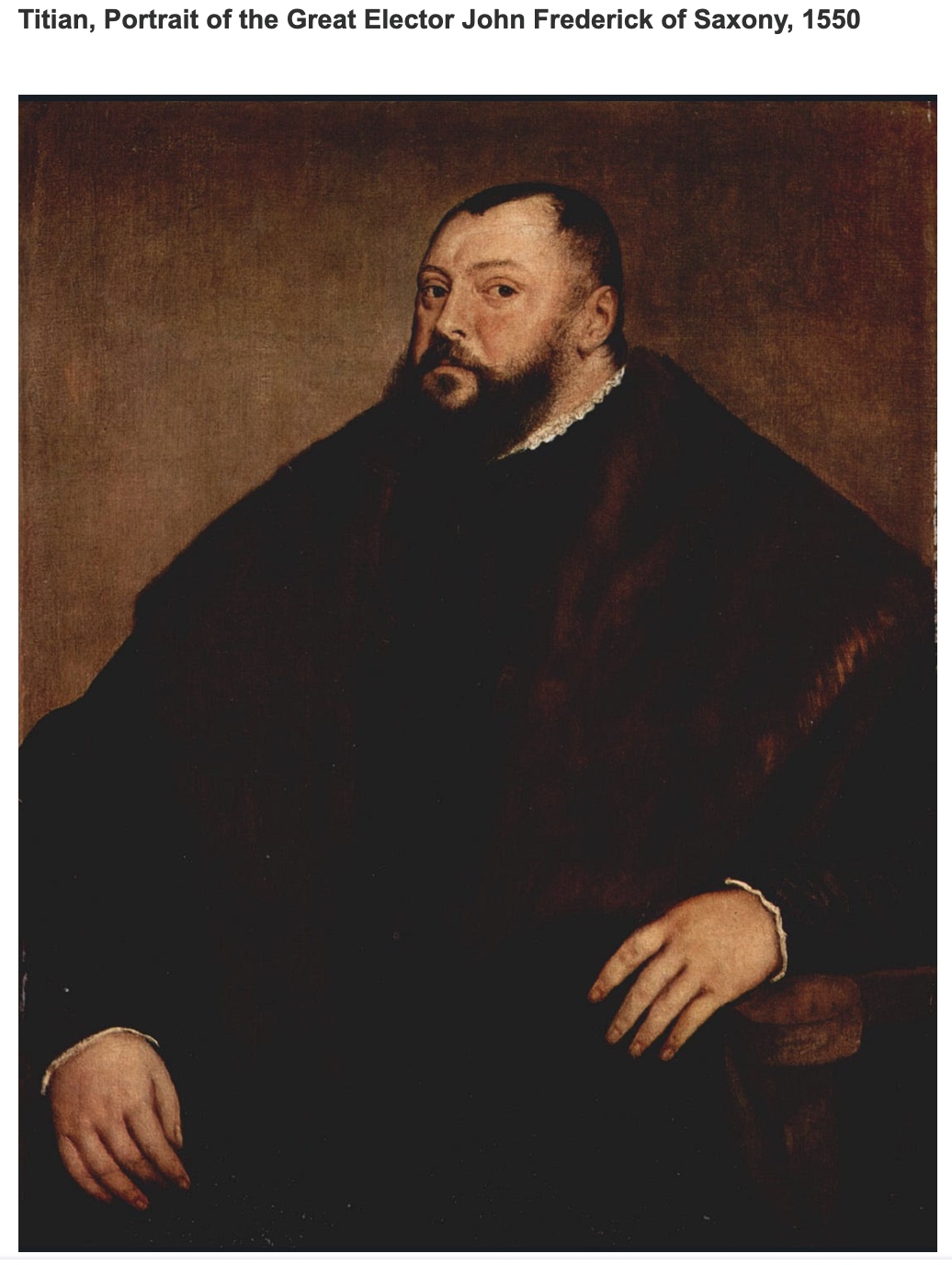
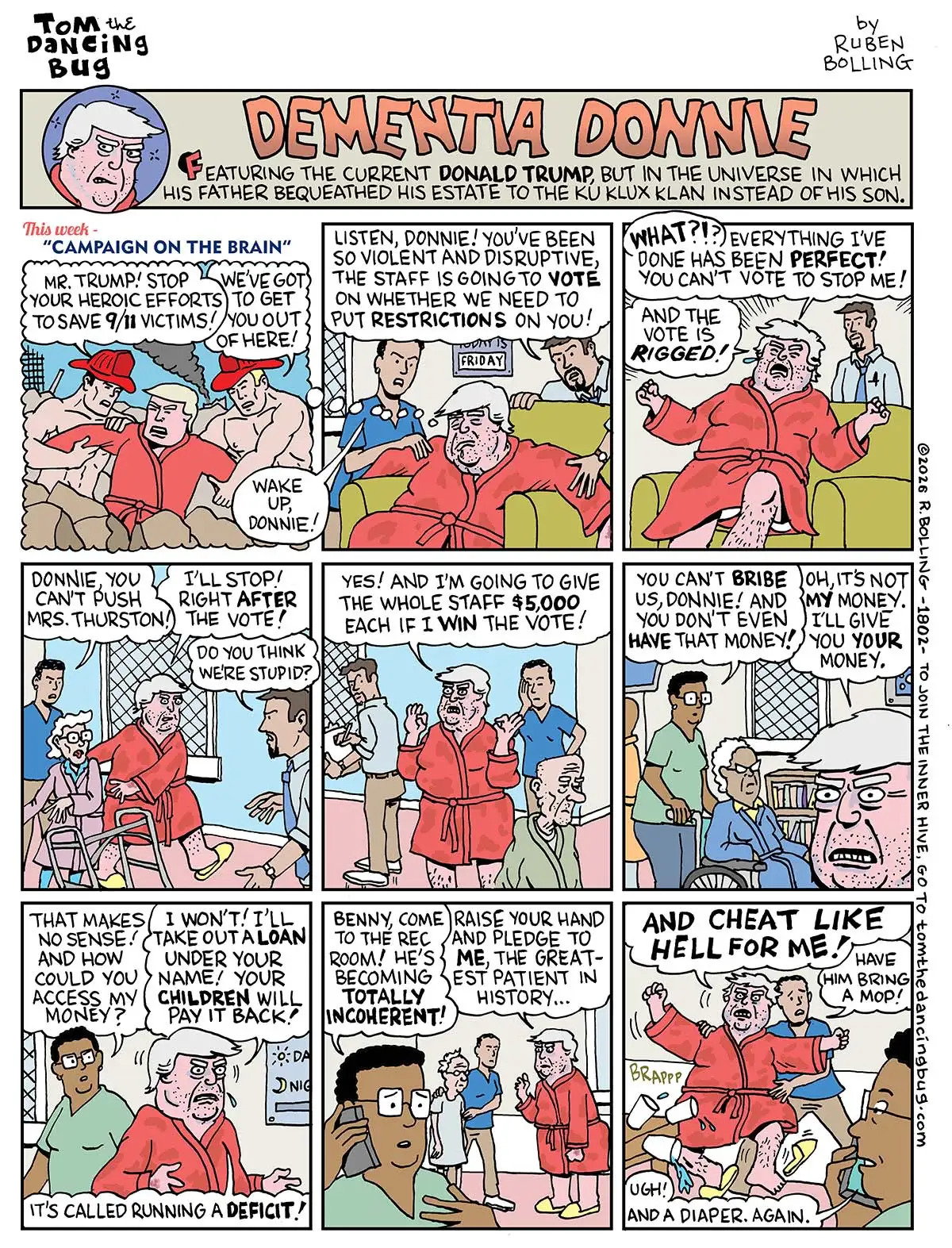
Onomastics in Interaction With Other Branches of Science
Toponymastics vol 1
Anthroponomastics vol 2
General and Applied Onomastics. Literary Onomastics. Chrematonomastics vol 3
Satellites Reveal America's Top 15 Methane Super-Emitters Dictionary Adds Words! languagehat
NYT:
Merriam-Webster, the venerable dictionary that traces its roots to a time before looksmaxxing and yacht rock, has added those words along with chili crisp, shapewear and cuffing season, to its comprehensive accounting of the English language. The company, based in Springfield, Mass., announced on Tuesday that it had added those five terms and 1,395 other new definitions to its online dictionary, Merriam-Webster.com.
18ix26
Bow Hunter's Syndrome
review article Stroke (2021)Bow Hunter's Stroke Barrow Neurological Institute
Bow Hunter's Syndrome Stroke Manual (2026)
Mapping the Lat Ice Age maps mania
Navigating the Modern Data Lexicon: A Working Vocabulary for the Semantic Era Jeremy Arendt at O'Reilly
The way we talk about data is changing faster than the way we build it. Every quarter a vendor ships a new approach, coins a new term for it, or quietly adopts a term someone else has been using and redefines it to fit the shape of their product. None of this is malicious. Every company describes the landscape from wherever they happen to be standing. But when six vendors do that to the same word, practitioners are left translating between six versions of it before a design conversation can even start.There's a second problem stacked on top of the first. Most of the vocabulary we use to talk about data in the AI era comes from academic disciplines that very few working practitioners have spent time in. "Data warehouse" is immediately legible: You know what a warehouse is, so you know this is a place where things are stored until someone needs them. "Ontology" is not. It arrives from philosophy by way of knowledge engineering, where Tom Gruber defined it in 1993 as an explicit specification of a conceptualization. That's a precise definition. It's also useless to a director trying to decide what to fund next quarter.
What follows is an attempt at a working vocabulary, written for the people who actually deploy these technologies and the people who approve their budgets. For each term I want to answer three questions. What is it, actually: software, an artifact, or a practice? What job does it do? And which kind of output does it serve?
Screenless Wearables Forecast a Minimalist Health-Tracking Future gizmodo
Paper Tiger: Trump's Lost Iran War is Making Everything More Expensive Ian Masters Interviews Juan Cole
19ix26
GeoWhisperer: See How the World Has Changed maps mania
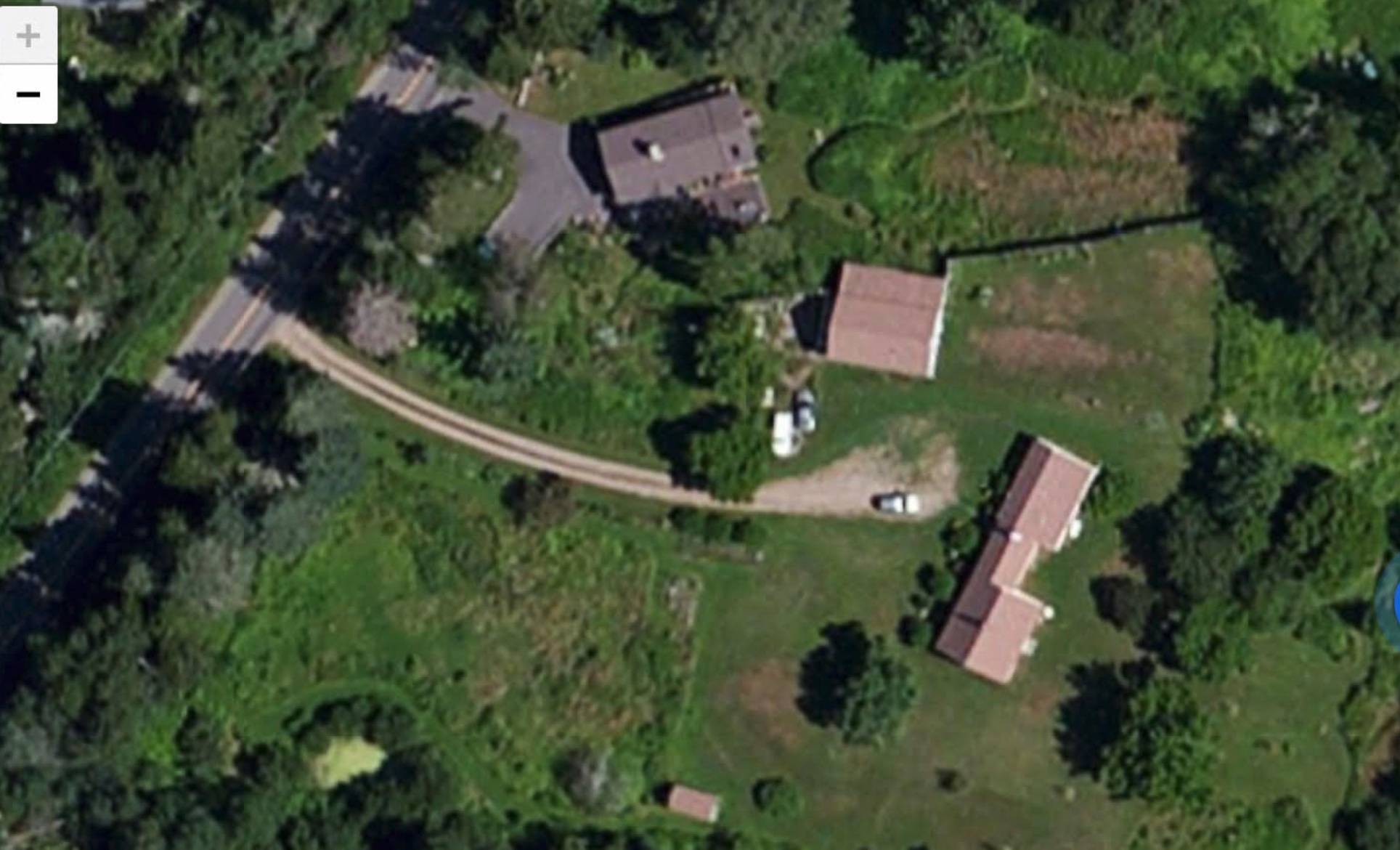
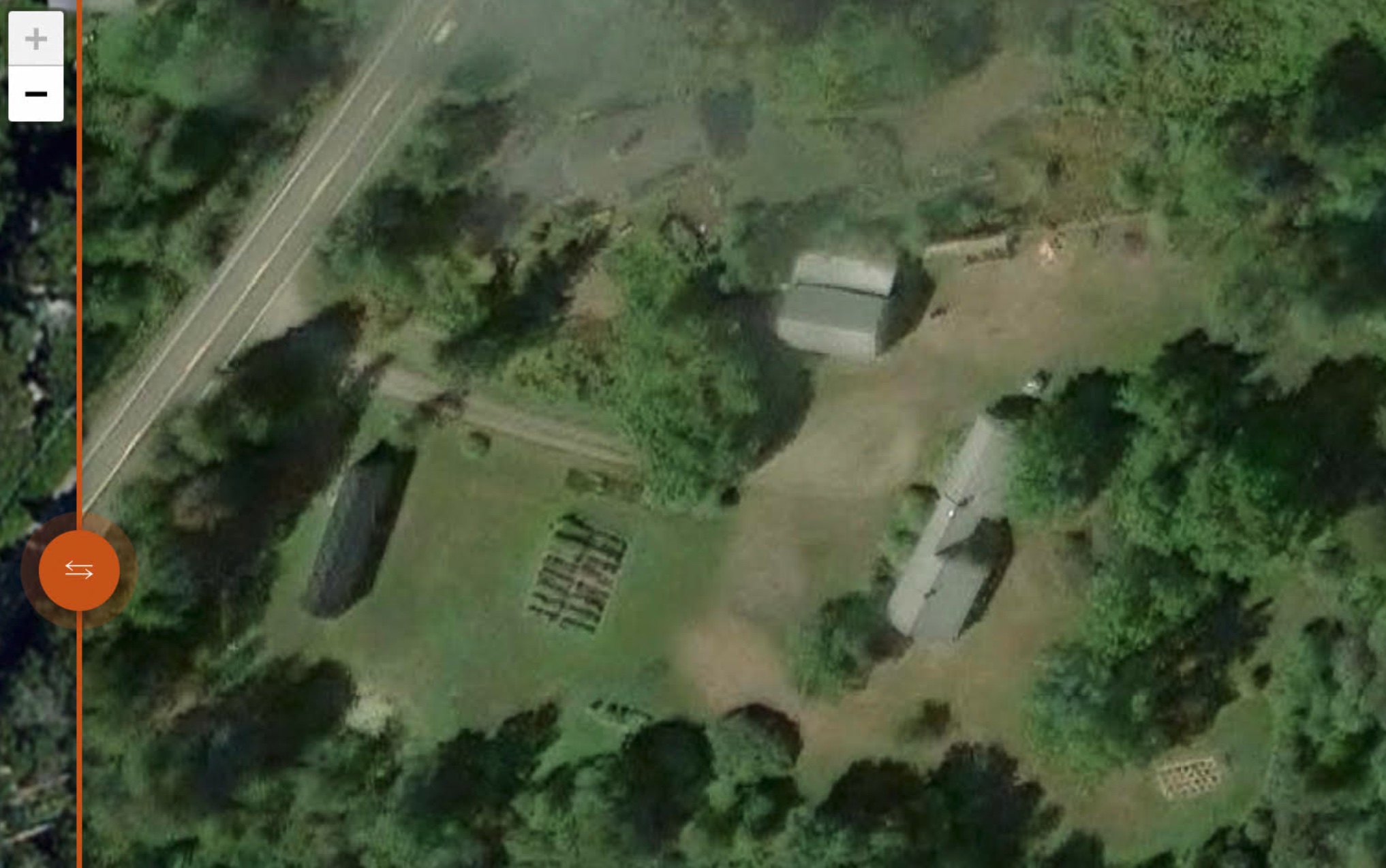
Economic Size and Economic Power Paul Krugman [My talk at the European Central Bank]
(on Dune):
the premise of the novel is that there's this planet, Arrakis, which is the sole source of something called spice, which is essential to the galactic economy. And so everything relies upon it. And so basically Arrakis is the Strait of Hormuz with giant sandworms. It is really very much relevant to current issues. By the way, the struggle for control of the spice leads initially to weaponized interdependence and eventually to outright war, which is kind of where we want to probably end today's talk.Let me give you two quotations. The first is from the novel, from the protagonist of the novel. "He who can destroy a thing, controls the thing." —Paul Atreides And the second is a rather more verbose statement from Albert Hirschman, who is the patron saint of geoeconomics, basically about how gains from trade are also potentially a tool of coercion: "The total gain from trade for any country is indeed nothing but another expression for the total impoverishment which would be inflicted upon it by a stoppage of trade."
...It is much more common for countries to be really dependent upon imports of something and to have no good alternatives than it is for exporters to have nothing else they can do. Not just because there may be many exporters—or other things you can export or other markets—but also because resources can be reallocated. So although there may be a significant number of people employed producing for a foreign market, they could be doing something else
...I try to not be too political here, but obviously we have an unusual, rather baffling trade dispute between my country and its northern neighbor. And the position of my president is that we don't need Canada for anything, that there are no benefits to importing oil and aluminum and electricity and so on from Canada and that we are subsidizing Canada and that all of the benefits from our trade together are the bottom triangle here. Okay, that is not standard economics.
I do worry that we may be a little too glib about dismissing the producer surplus side or the export side. Partly that's because there are situations in which the resources that are being used to produce and export do not have readily available alternative uses. And if you want an actual example that is relevant to this current thing: Athabasca tar sands in Alberta, Canada. At the moment, there is no real other place. Your oil is being extracted in Alberta and is shipped to the American Midwest through pipelines. There is limited pipeline capacity that can take it off to the Pacific Ocean, but not much else. In this case there is actually a producer surplus that's being generated by the ability to export the oil and the cutoff of that trade would hurt Canadian producers. So there would be some welfare loss there.
...With all of this craziness, one of the things that we're witnessing happen in the current oil crisis is that on day one there was really no alternative to the Strait of Hormuz. As time goes by, however, you find ways around. You find ways to substitute, alternative routes. In some sense, the elasticity of demand also rises over time so that the power that comes from the ability to disrupt trade is a wasting asset. You can use it for a time, but not indefinitely.
...even the example I've been using of Canadian oil, oil is a globally traded commodity. We do talk about a world price of oil, but in fact, I did say that the Canadians really have at the moment no alternative buyer. Their oil pretty much must be shipped to the US Midwest because that's where the pipelines run. It's also true that the U.S. Midwest has basically no alternative to the Canadian oil. A lot of oil being produced is from the Permian Basin, but the pipelines don't run that way. And also it turns out that oil is not oil. That the Canadian oil is heavier and the Texas oil is light, sweet crude and for certain things, they need the heavier, sticky stuff that comes from Canada.
So, pretty much everybody has some market power. So,I don't know. Maybe grain exporters? Though, I suspect that if I got into the wheat market I would learn that wheat is not not wheat. That there are different varieties and all of that.
...we were talking about hegemonic systems of world trade and what happens when we have a flip and the United States is no longer the dominant economy and how does that affect the system? But that's not a prospect. That has, by many measures, already happened and a lot of what we're trying to understand now is what we do in a world where that has already happened. I've been writing about this because it's both important and also I think intellectually very interesting.
So one of the ways we can compare economies is purchasing power of their GDP. Now you might say why not just use dollar values? And the answer mostly is just instability. If you are going to compare the Euro area with the United States, it looks as if something terrible happened to Europe after 2008, but mostly it's just that the Euro declined against the dollar. It's not mostly a real movement in the two economies. So you would basically use something like purchasing power parity to smooth it out.
And if that's the criterion we use, well, there's a clear number one economy in the world, and it's not the United States. And if we do the US-European comparison, actually, there are three economic superpowers in the world by this measure. There's the United States, there's China, which is clearly number one, and then there's the EU, which are roughly co-equal. It's not the world as the U.S. Treasury Secretary would portray it, let's say, but it is the world that the standard numbers do.
...So, just how big are these economies? How much stuff do they produce? We are now in a tripartite world, at some level almost co-equals except that by the numbers China is clearly the biggest. And then there are questions about political cohesion—the ability to act as a unit which is arguably the really big difference between the United States and Europe. That's the world we're in now and so any discussion about geo-economics, any discussion about hegemonic stability should bear in mind that, look, there is no hegemon, not by the numbers. China is not yet big enough to be the hegemon, but the United States truly is not big enough to be the hegemon. So we are just not in that world anymore.
... how do you compute economic growth? We often talk as if economies produced a "thing." We talk about “one-good economies.” And, you know, that's a very helpful thing, but it is, of course, a metaphor. And sometimes the metaphor can fall apart in a couple of ways. And one of them is that, obviously, many of the goods that we use and live by in the year 2026 didn't exist in the year 2000 or have been so transformed as to be fundamentally incomparable. So how do you take account of that? And the answer is hedonic measures. You try to measure, in effect, what is the value of the extra stuff that this new good delivers? And again, the statistical agencies put a lot of effort into this, but there is no international standard for hedonic adjustments. We don't actually all do it the same way. And although it's hard to document—though it appears to be the case—it does look as if the US statistical agencies are a little more aggressive in their hedonic adjustments than the European agencies are, so that the United States may be assigning greater value to smartphones in some sense than Europe is.
...Taiwan is a quite small economy, and yet, if you really want nightmares about possible disruptions to world trade, the idea that something would happen that would disrupt Taiwan's supply of a large part of the world's semiconductors is a really big deal.
...one thing Europe definitely does lack is a venture capital sector comparable to the United States. But where is the venture capital sector in the United States? It's not just Silicon Valley, it's Sand Hill Road. It's probably just a square kilometer or so of the United States, which is where all of that stuff is.
...ASML
...one thing I happen to know just from the economic geography stuff is that most of the world's buttons are produced in Qiaotou, China. I'm not sure, but it's possible that if the world loses its supply of buttons, that might actually be a bigger deal than people realize.
...If we want to ask why the world changed so much two years ago, it was not because there was a real change in objective conditions that meant that countries should have different objectives. It's just that countries did have different objectives, and there they are.
...What is the relative willingness to bear pain? With U.S. vs. Canada, I don't really know whether we can measure the dollar value of the costs of trade war. It might be less asymmetric than people think. It might actually be almost comparable, at least in terms of dollar losses, but of course as a share of GDP, it will be enormously higher for Canada. On the other hand, the Canadians kind of know why they're doing what they're doing. And certainly the great bulk of the U.S. public has no idea why we're doing what we're doing.
Reanimating Doc Searls
...last week, I asked Claude for help. I pay Anthropic $20/month* for Claude's services (Sonnet 5 at the moment), and it successfully rescued both my old blog and every item I ever submitted to Linux Journal. They are now at searls.com
Yes They Want to Kill Us: The Worshippers of Machines Versus Human Beings Rebecca Solnit
...It says a lot about the status of Silicon Valley corporations in general and AI's lead corporations in particular that some suggested that this was a PR stunt, destructive power being a form of power and power being exciting to lots of individuals. It became clear that a lot of people deeply distrust everyone in the industry, especially its leaders, and are reluctant to take anything they say at face value. A lot of questions were raised about the CEOs' sudden expression of willingness to slow down and be regulated..Meanwhile, my climate associates pointed out that we don't have to wonder if AI might try to destroy the world. With its huge fossil fuel consumption for data centers, on a scale that could make AI equivalent to a big new nation with a big new carbon footprint appearing, AI-invested corporations are doing their damnedest to destroy the earth right now. That is: rather than look ahead to potential dangers, we should look at the destruction afoot right now. Bill McKibben writes, "one way to understand a data center is that it's a device for burning natural gas, the latest excuse (after Ukraine and Iran) for the fuel that Big Oil is counting on to keep its business model afloat even as the world turns away from internal combustion cars and crude demand begins to drop. The degree to which this is becoming a climate disaster can hardly be overstated."
...in Minnesota, litigation is ongoing in a case against United Health, which was charged with "illegal deployment of artificial intelligence (AI) in place of real medical professionals to wrongfully deny elderly patients care owed to them under Medicare Advantage Plans by overriding their treating physicians' determinations as to medically necessary care based on an AI model that Defendants know has a 90% error rate."
...t's not just the oligarchs; a lot of workers inside the industry have apparently taken up worldviews far removed from those of the rest of us. Inside the tech bubbles is a deeply flawed notion of our humanity that seems to reduce us to our brain functions, specifically brain functions that machines can do and maybe do better. That comes, it seems to me, of deep alienation from one's own biological, spiritual, and emotional nature, the embodied foundations of consciousness, the valuation of life itself, and the earth as the source of it all. Nature in this view is at best something to defeat or transcend;
...…a conference that [tech oligarch Peter] Thiel's venture capital firm hosted just before the election in 2024 that was called Hereticon, 'a conference for thought crime.' And the tagline was: 'Maybe if you aren't trying to destroy the world, you aren't trying hard enough.' We've been wrestling with how to talk about what they say because some of it is so nuts that you sound a little kooky quoting them. Elon Musk saying it increasingly looks like 'humanity is a biological bootloader for digital superintelligence,' or that we should rejoice in the fact that they're building the digital beings who will come after humanity." That is, they are willing to gamble on destroying our species and systems of survival because what they value is a narrow part of the spectrum of human consciousness that can theoretically be preserved and extended by machines, in which case we the biological species are dispensable. The vision of machines clacking away on a post-human planet in the near future is, to me, dismal and barren. But Nathalie Marechal at Tech Policy Press confirms its reality: "According to this belief system, these synthetic, all-knowing beings may be morally equivalent to people, as they will contain 'the light of consciousness,' to use Musk's preferred phrase, whatever that means. What's more, believers anticipate uploading their 'consciousness' to the cloud and merging it with AGI to create 'posthumans' or 'transhumans' who will eventually succeed homo sapiens as the universe's apex species — a 'worthy successor' to humankind. And they are so excited about this grim future, they're willing to go to extraordinary lengths to get there. The billionaire believers in the cult of AI are perpetuating a 'coup from above' — to quote Shoshana Zuboff — to build a world that caters to their every whim and desire without the need to persuade or even coerce other people to do their bidding. The dream of the AI cult is a world where people are superfluous, or exist only as extensions of intelligent machines."

20ix26
Intergenerational Space Travel thisamericanlife

21ix26
A Massive, 2,000-Year-Old Iron Haul Could Rewrite What We Know About Ancient Trade gizmodo
The 540 Million Year History of the USA maps mania
The Unique World of Panoramas“ Michael Alford on Medium
...A conventional photograph has a frame. A panorama weakens that frame, or even destroys it. It actually involves a more natural way of seeing than a conventional photograph does. It makes us move our eyes and head around the way we do in a real place. Instead of an object of attention, a panorama is a space of attention — an environment.
What is a Metameme? Hanzi Freinacht at Medium
...the much broader field of social and cultural development. The socio-cultural stages contain so much more than just values and worldviews, such as all the technological, political, institutional, and artistic aspects that make up the whole of a society...Memes (not to be confused with the illustrated jokes people pass around on social media) are non-physical self-replicating units of cultural information that are transmitted through signs and symbols. Think of all the ideas, inventions, attitudes, behaviors, and styles that spread among people through writing, speech, gestures, rituals, and so on within and even across cultures. You can see them as culture's equivalent of biology's genes, or as the "building blocks" of culture.
...The reason I didn't just use the already existing term "memeplex", which is short for "meme complex", is that this word refers to any large and coherent pattern of memes. This includes stuff like languages or dances or rituals or architecture. The metamemes are a subsection of the memeplexes; they are the patterns of how cultures can be described in developmental terms; if you will, in developmental "stages". Metamemes are specifically defined, very large, memeplexes; and they evolve in a recognizable and logical sequence (hence "developmental").
...ballet sprung out of fencing and the court society centered and modeled on early modern France. Like a racing car, ballet is based upon removing all but the most necessary movements to achieve the goal of winning. In a sense, it's ultimately utilitarian. That's what creates its elegance. It's Ockham's razor applied to the movements of the human body. It's the Enlightenment paradigm embodied in motion.
...simply a point about the non-arbitrary nature of history. History is structured. It's not, to use a worn expression, just "one damned thing after another" (ODATAA). History has melodies; I would say, beautiful ones. And it has a certain direction, albeit a meandering one that easily gets interrupted.
...we can and should remain agnostic about any such force. The moment we start believing in such an entity, and that we can somehow intuitively or intellectually tap into this force and serve its purpose, we become tunnel-visioned “"rue believers", fanatics set on a particular direction of history and thus blind to the multiplicity of perspectives and the richness, contradictions, and paradoxes of history. We implicitly take ourselves to be prophets, speaking the word of God, which — again — belongs to no one: An unforgivable vanity, a cardinal sin.
...It would be more accurate to say that evolution "stumbles forwards"; it doesn't really see where it's going, or why. People like ourselves can think we know where we're going. But the universe always surprizes us, and the stumbling march of history always turns out to be orthogonal to what we imagined. It feels more likely, then, that we live in a universe that also surprises itself.
...Take something like the Russian Empire — there is little if any apparent connection between the presumably Viking (or Varangian) chieftain Rurik's establishment of Novgorod in 862, the rise and fall of the Kievan Rus, the regrouping of post-Mongol Russian power around Moscow, the purges of nobility under Ivan the Terrible, the establishment of Saint Petersburg under Peter the Great and the thousands that died in the process, and the defeat at the Crimean War, and the royal court being enthralled by the crazed faith healer Rasputin in the early 20th century — and the emergence of the Soviet Union and its role in the Cold War, as well as its collapse some 80 years later, with resulting stagnation and failed transitions to liberal capitalism and the invasion of Ukraine in 2022. If there has indeed been a directionality and pattern to this evolution, it has certainly been one full of contradictions, blunders, and meaningless failures and mistakes.
...The whole thing doesn't "see where it's going". Today's Russia stumbled itself into existence through failures, tragedies, and paradoxes — through twists and turns of human ingenuity, vanity, tragedy, and sheer stupidity. As did all of the world's nations. Crash, boom, bang, oops — death, decay, suffering untold. Tragedies and cruel jokes at the expense of the human spirit. Absolute absurdity. And in the midst of it all: creation — the emergence of the utterly unexpected, the stumbled-upon, which still somehow germinated through many criss-crossing patterns of human agency, foresight, and intentionality.
...Historical evolution has recognizable patterns and directions, but probably no "end-goal" or "telos". And if it has no end-goal, it has no particular "destiny", either. I view our intentions and goals for society nihilistically; they may serve as necessary little "religions" for us, but they never turn out to be right. And thus nobody is destiny's child or God's prophet.
...The metamemes are not like time periods, i.e. like Antiquity, the Middle Ages, the Renaissance, and so on. The philosopher Theodor Adorno famously argued that "modernity is a qualitative, not a chronological category". What he meant by that is that it's not really meaningful to try to understand at what particular time the world "became modern" — the answer to this will vary depending on the context. Much of the world still today isn't modern in a meaningful sense of the word. Rather, one must struggle to understand why modernity emerged, through which mechanisms, which properties delineate it from non-modernity or pre-modernity. That would be the only usable explanation, because that's what has real explanatory, and, ultimately, predictive power. That's also how the classical sociologists of the late 19th century approached the study of modern society.
...They are certain patterns of history — certain qualities, certain properties, certain logics, certain dynamics. They're large patterns-of-patterns; they're overarching patterns-that-connect. As such, metamemes stretch across and through any crude periodization we may conjure up. They slip through any attempt to catch them chronologically, to freeze them in time
...The metamemes are qualitative categories. That is to say, you can describe how they work. What they do. What they are. Now that is truly an explanation. Saying something is "medieval" or that it happened in 1212, is not.
How To Use TK To Turn Your Notes Into Beautiful Essays Niklas Göke at Medium
Thinking is all there is Berndt Mueller at Medium
...Four questions are usually handled separately, by metaphysics, physics, neuroscience and computer science. Why is there something rather than nothing? Why does it have these laws and these constants? Why does any of it feel like anything from the inside? And what would it take to build a machine that thinks? Observer Patch Holography (OPH) gives one answer to all four, and the answer is a single operation: two neighbours who each see part of the world compare where their views overlap, repair the disagreement, and keep a record. Run it on a finite network and out come, as machine-checked theorems and reproducible simulations, three dimensions of space, one direction of time, the causal order, quantum probability, gravity and the forces from one move on two channels, the particles, and two constants of nature to several decimal places, with no adjustable number anywhere. Run it inside a body and out comes a nervous system. Run it in a room of people and out comes a conversation....Everything starts from perfect equilibrium, which holds no record and represents nothing; a something is that symmetry broken by a small amount. Qualia, the felt qualities of experience, the redness of red as against its wavelength, are present wherever the operation reads its own state, and a three-line proof says they must be. Your brain is a region of the network thinking about the network. And the universe generates observers because a universe without them cannot exist, which is a fixed point rather than a paradox, because time is one of its outputs.
The Claude Delusion Cory Doctorow
It's hard (or perhaps impossible) to avoid the reflex to impute intention to things that seem to have intenders. Think of your autonomic, unavoidable emotional response to the fictional characters you encounter in literature. Feeling sorrow or joy for imaginary people is weird. They aren't real, and you know they aren't real, and yet you may find yourself moved to tears by their plight....To "converse" with an AI is to carry on a dialog with a fictional character, who is no more real than the imaginary people in a novel. Indeed, the chatbot is less real than the character, because the character is the product of another mind, while the chatbot's words are the product of complex mathematical operations conducted over a massive database of all the words humans have uttered, arranged by their frequency in relation to one another. When that math makes something beautiful or striking, it's like a sunset: no matter how striking it is, it's empty. No one chose those colors. No one chose those words
...To the extent that AI still surprises me, the surprise is about how much smoothness there is in our real world. The fact that AI can use statistical prediction to answer questions or carry on conversations tells us something important about how regular our real world is. It doesn't prove that statistical prediction is the same thing as understanding
...What makes a great writing teacher — and what helps to produce great writers — is spotting the non-standard aspects of a student's work that can be developed into a unique and powerful voice. Anyone can help you with the smooth parts of becoming a better writer. Only a good teacher can help you find and refine the texture that will make you a unique writer.
...ascribing personhood to chatbots is nothing like ascribing personhood to nature. Indeed, it's fundamentally incompatible with "rights for nature." Think of the abomination that is "corporate personhood": by extending personhood to this human construct, we have made a world where artificial lifeforms –—limited liability corporations — can destroy nature and drive animals to extinction. If we extend personhood to these climate-shredding, water-chugging AI models, their personhood will demand the sacrifice of animals, the natural world, and our own wellbeing
Into the darkness? Chris Bertram at Crooked Timber
...now we find ourselves on the edge, or perhaps over the edge, of a descent into a world where such visions of freedom and equality are unimaginable and where, to borrow a cliché, resistance is simply futile. The herald of this predicament was Edward Snowden, who revealed how comprehensive a monitoring of individual thought and action was possible in the world of the internet. Anyway it has turned out that, for most of the population, privacy is something they are perfectly happy to sacrifice, just so long as the algorithms end up being better tuned to the satisfaction of our wants and desires. And progress is no long measured in terms of our liberation from various forms of oppressions but rather in the ever increased abilities we have to acquire and consume, even if that comes at the expense of the natural and physical basis of our very survival.Benjamin Constant thought that a private sphere was one of the constituent parts of the "liberty of the moderns", and if he was right then Snowden's revelations and, subsequently, the panopticon of the tech oligarchs have put an end to freedom already. But it is one thing, perhaps, to have all that information about us and to put it to effective use beyond the satisfaction and shaping of our consumer choice. Well, a first step in politics is to tailor our information environments so as to manipulate us, or enough of us, to cast our votes in favour of the preferred candidates of crypto billionaires, and we are already beyond that stage thanks to the likes of Palantir. It turns out that enough of us can be scared by the threat of "illegal immigrants", "fighting-age males", "grooming gangs" or simply brown people standing up for their rights, to make it likely that far-right populists will take power in parts of Europe as they already have in the United States. And when they are in power they will benefit from the fact that our conventional and sensible politicians have already weakened or removed the guardrails that limit state power, undermining human rights and criminalising those who have been active in protesting the climate emergence, the Gaza genocide or the tens of thousands of migrant deaths.
After the dollar as reserve currency Adam Tooze
...Of course we should be thinking about the future and America's decline. But what is misleading about this framing, is the assumption that the dollar's main role right now, is as a "reserve currency". That depends, as the name suggests, on policy-makers in major economies around the world accumulating reserves. That was certainly true in the early 2000s. And given the size of global imbalances, net claims continue to change hands internationally. But a lot has happened in the world of global finance over the last generation. And compared to the early 2000s, one of the most dramatic shifts is that official reserve accumulation has decelerated sharply. This shift, which happened in the mid 2010s, is brought out beautifully in graphs by Karl Schamotta, whose work I want to highlight in this post along with that by old Chartbook-friend Brad Setser.This great chart from Schamotta highlights the danger of talking in 2026 about global reserve currencies as though we were still in the 2000s. In fact the period from the early 2000s to the mid 2010s actually was, both compared to the decades before and the decade since, extremely unusual. Being a "reserve currency", in the sense of being the currency and issuer of assets in which official reserve managers around the world openly stash their trillions, is not a historical structure that can be taken for granted. It is not how the dollar generally functioned after 1945. It is not how sterling functioned in the beforetimes. And there is no particular reason to expect the 2000s model to apply to some other currency in the near future. Being a reserve currency in the 2000s sense appear to have been a historically unique configuration conditioned by defensive responses to hyperglobalization on the part of EMs, Asian exporters, petrostates and China. As Brad Setser pointed out in a comment on Schamotta's graph, there is a tight correlation in time with the surge in US Treasury issuance — the asset in which much of the unprecedented reserve accumulation was invested. Since round about 2015 a new configuration has emerged in which Treasury issuance continues, even as reserve accumulation levels off.
...net purchases of US assets by foreigners have since the early 2020s shifted decisively towards funding corporate America not the US Government.
...the question of which currency will succeed the dollar as the "world's reserve currency" is misleading because it supposes that the configuration of the 2000s is normal. Whereas, in fact, it was exceptional. Today, the dollar already no longer functions as "the reserve" currency in the way that it did in the period 2000-2015. Today, surplus countries like China go out of their way to obscure their accumulation of claims and to divert them into all sorts of "non-official" channels. To be accumulating reserves as in the 2000s would be an embarrassment. The function that the dollar performs for the world economy today is principally that it serves as the medium for complex financial engineering on a global scale, and furthermore as the gateway to what continue to be the largest and most lucrative financial markets in the world.
Two parallel neural ectoderm progenitors contribute to the developing brain Rayyan T Jokhai et al. Nature Neuroscience
...Two parallel brain progenitors emerge simultaneously during gastrulation: anterior neural ectoderm (forebrain/midbrain progenitor) and posterior neural ectoderm (hindbrain progenitor) ... we postulate the brain is a composite organ emanating from two lineage-restricted progenitors; these dual progenitors may be evolutionarily conserved across 550 million years from hemichordates to mammals....It was long presumed that the mammalian brain develops from a single progenitor cell—the very first brain stem cell, if you will. But when researchers looked closely at the early stages of mouse brain development, they realized that the forebrain and midbrain—the big, wrinkly parts that do most of what we consider "thinking"—grow from a different cell line than the hindbrain, which regulates automatic actions like breathing and hunger.
...This could help explain why researchers have struggled to grow hindbrain neurons from neural stem cells.
...the results line up well with the fact that jellies, among the oldest lineages of animals with nerves, have two nervous systems. "Even 500 million years ago, there were these separate neural systems, which now almost operate as one, which is very cool," says Jokhai.
Gastrodome: O Is For Omelette Timothy Burke
...You don't have your special favorite pan when you're on vacation and have access to a kitchenette. You're staying over at a friend's house and you offer to make omelettes. You got lucky last night and you want to make an omelette for a apres-intimacy breakfast before they leave. The omelette breaks, it fails, it burns, it's too liquid.You start to overstuff your omelettes in compensation. Then you put almost nothing in them and they taste like the cheap pre-formed omelettes you get in mediocre diners. The omelette becomes less a miracle and more an ordeal.
You buy a new special pan but then you read more about no-stick pans and PFAS and you resolve to get rid of it. You find a special Japanese omelette pan for making tamagoyaki and decide to do that instead. You find that harder. You see a Korean-made pan where you just fold the pan over, almost like a waffle iron, to make an omelette. It doesn't work half the time. You have been cursed by the omelette god for your presumption.
There are ways out of the omelette trap. Make frittatas or quiches, and there's no obligation to shape them right and get them out of the pan. Go back to scrambled eggs but with additions: scallions, cheese, smoked salmon, ham, diced bell peppers, and you have something that might as well be an omelette. Function over form! Down with the tyranny of culinary aesthetics! Get a teeny-weeny pan or put mixed eggs in a greased muffin tin and make little egg pucks to put in breakfast sandwiches. Make baked eggs in a bain-marie and serve with toast points, that's very fancy.
23ix26
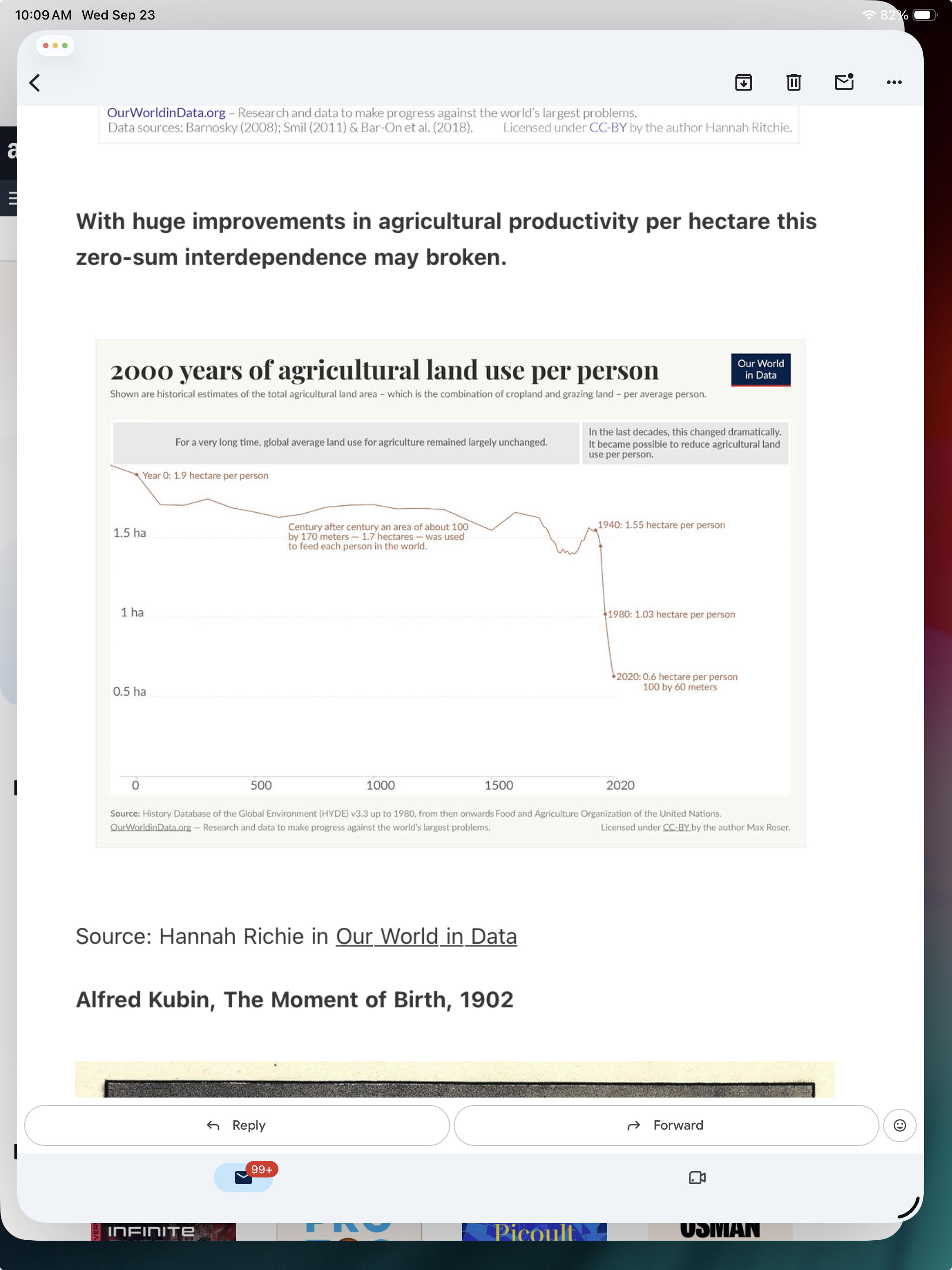
Big tech guarantees Adam Tooze
As world leaders head to the UN General Assembly in New York this week, we confront a paradox. The global community is more interdependent than ever, even as it becomes more fragmented and polarised. Our economies are deeply intertwined. Technology links billions of people across borders, while capital, goods, data and ideas move at speeds that would have been unimaginable when the UN was founded in 1945. Global trade reached a record $35tn last year and 6bn people — almost three quarters of humanity — are connected to the internet. However, geopolitics is moving the other way. 2025 saw 65 state-based armed conflicts across 35 countries, the highest number recorded since 1946, while global military spending rose to a record $2.9tn.International law is under strain. The language of spheres of influence and power politics is back. Economic ties are increasingly used as instruments of pressure and coercion while inequality is on the rise, both within and among countries. Some may conclude, therefore, the multilateral system has failed. In part, that criticism is understandable. A multilateral system that fails to reflect the realities of today will not survive the test of time. But the need for multilateral co-operation is very much alive. The postwar world is long gone, but the underlying logic that justified multilateral co-operation is more evident than ever. The climate emergency is going beyond even the most alarming predictions. AI is advancing faster than our capacity to control it. Pandemics can spread across continents in weeks, while financial shocks can disrupt markets in hours. Armed conflicts can destabilise entire regions and force millions to flee from their homes. Global maritime chokepoints, such as the Strait of Hormuz, constrained by conflicts, can paralyse supply chains around the world.
No country, however powerful, can manage these challenges alone. Cooperation is therefore not an act of idealism, it is a practical necessity. The question is not whether multilateralism can survive, but how it must evolve to meet the realities of our time. In this context, we are coming together with a new initiative: 'Partners for Multilateralism'. ... UN secretary-general António Guterres recently said that "superpowers are discovering their limits". We believe that the international community must rediscover the extraordinary potential of collective action. ... The real choice is not between preserving the international order established after the second world war or abandoning it. It is between renewing multilateral co-operation in a changing world, or allowing polarisation and power politics to define the next era.
Source: Financial Times
Art and the Snapshot Michael Alford at Medium
...What makes snapshots interesting is that they are about social situations — humans pursuing the acts of being human. Birthdays, marriages, parties, children playing, pets, graduations, dates, games, and vacations. Human life — pretty much art's main subject....consciously adopting a snapshot mentality may be the best response to our worries about AI. Snapshots and AI are the opposite poles of "non-art." Snapshot photography is messy, awkward, and full of mistakes. AI "photography" is derivative, conservative, and clichéd. Snapshots take chances. AI doesn't.
You Think Amazon Makes Money Selling You Things. It Does Not. Liora Daven at Medium
...the deeper logic, the one that took a decade to fully reveal itself, was that running this flywheel required building infrastructure. Servers. Data centres. Logistics networks. Payment systems. And once you have built infrastructure at that scale, you can rent it to everyone else....Amazon built the world's most sophisticated logistics and computing infrastructure to run its own store, then sold access to that infrastructure to every other business on earth. The store funds the infrastructure. The infrastructure generates the profit.
...Amazon's advertising business generated 68.6 billion dollars in revenue in 2025, growing at roughly 22 percent annually. That makes it the third largest digital advertising platform in the world, behind only Google and Meta, and it is closing the gap.
...Amazon occupies a position in advertising that neither Google nor Meta can fully replicate. It sits at the moment of purchase. A Google ad reaches someone who might be interested in a product. An Amazon ad reaches someone who has already typed the product name into a search bar, with a credit card saved to their account, on a platform where they can buy in two clicks. That proximity to the transaction makes Amazon's advertising inventory extraordinarily valuable to every brand selling consumer goods.
...The brands selling on Amazon effectively pay Amazon twice. Once in the commission Amazon takes from each sale, which runs between 8 and 45 percent depending on the category. And once in advertising fees to make their products visible to Amazon's own customers on Amazon's own platform. The marketplace creates the dependency. The advertising monetises it.
...Prime is not primarily a delivery service. It is a commitment device. A Prime member who pays annually has already spent the money. Buying elsewhere means leaving value on the table. The annual payment converts casual Amazon shoppers into reflexive Amazon shoppers, because the marginal cost of any individual purchase feels like zero once the subscription is in place.
...The data Prime generates is equally valuable. Amazon knows not just what its customers buy but how frequently, at what price points, in what categories, and how their behaviour changes with income shifts, life events, and seasonal patterns. That data informs AWS pricing, advertising targeting, and the product development decisions of Amazon's own private label brands, which sit alongside the third-party sellers whose data helped Amazon decide to build them.
...Walmart is profitable. Target is profitable. Costco is profitable. All of them use that retail profit to fund operations, pay shareholders, and grow. Amazon uses its retail operation as a loss-leader that generates customers, data, and market share, then funds the whole thing with cloud margins and advertising revenue that its retail competitors cannot replicate because they have not built the underlying infrastructure.
...You are not Amazon's customer in the conventional sense. You are simultaneously a customer, a supplier of data, and the audience that makes Amazon's advertising inventory valuable to brands. The 716 billion dollar revenue machine runs because those three roles are played by the same person, simultaneously, every time someone opens the app.
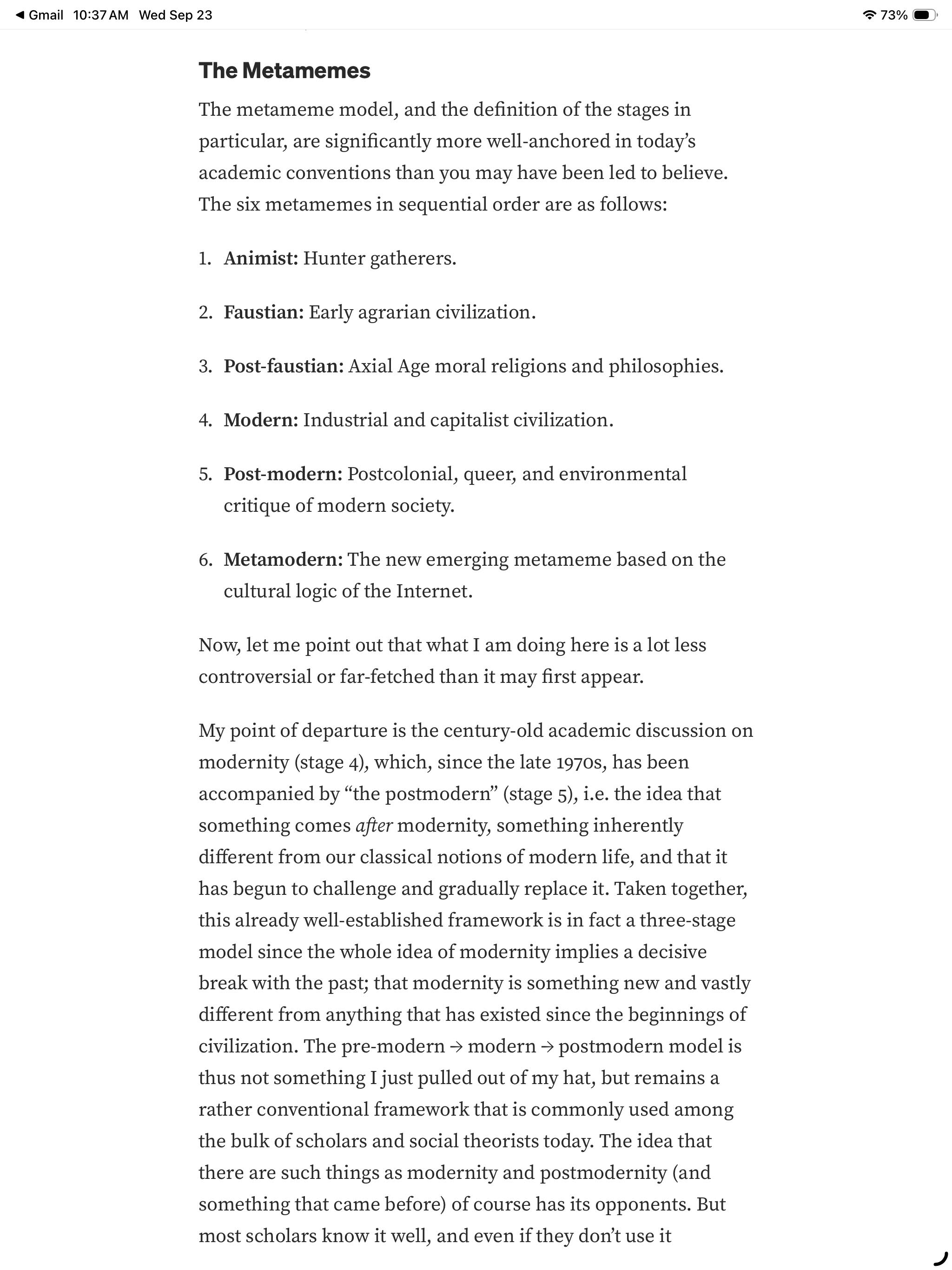
Lucy Sante on Pauline Kael, Film Criticism, and Pop Culture The New Yorker
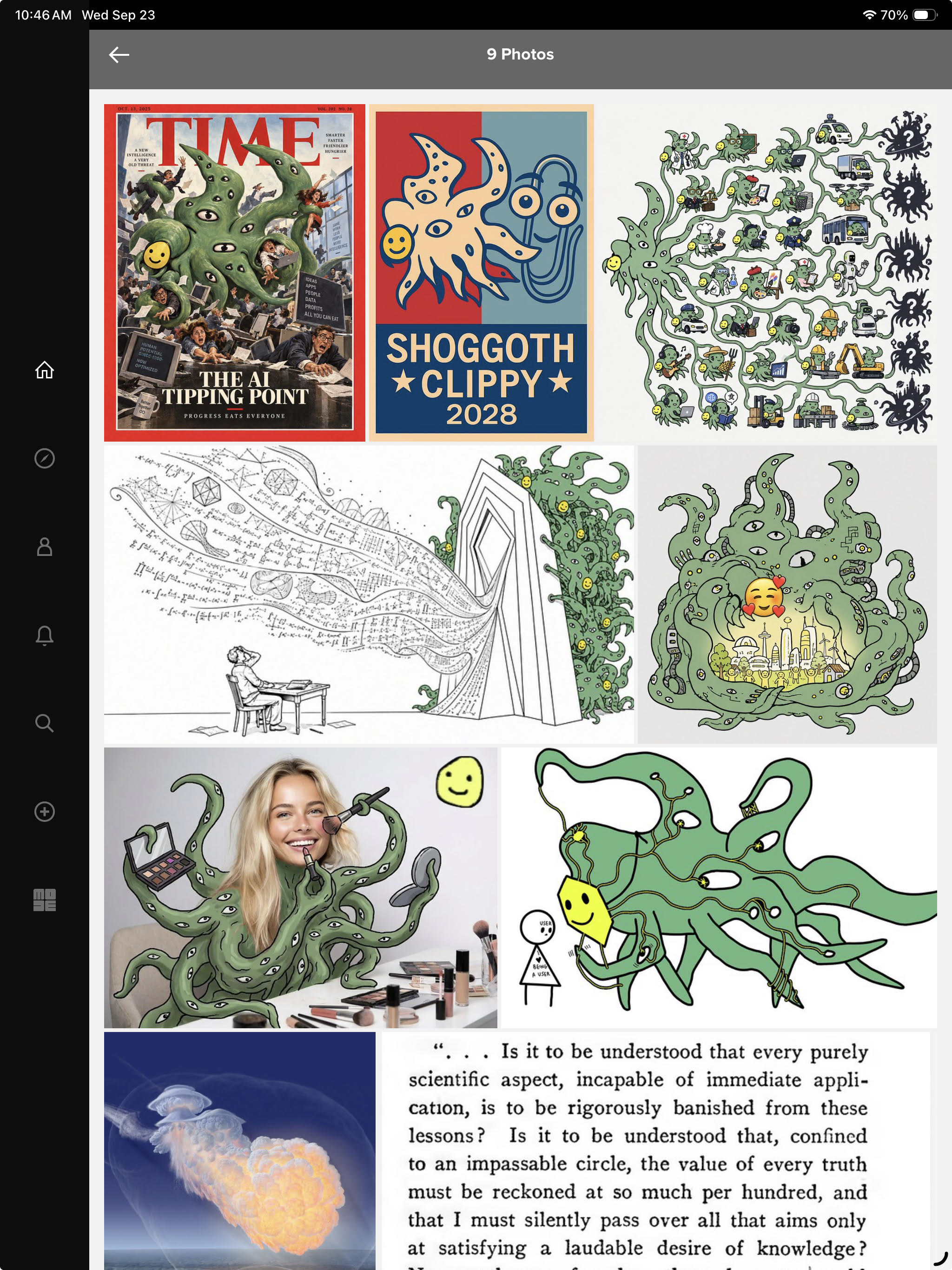
Cosmogonic Philosophy Andy Ilachinski
24ix26
Impressions of Theophrastus Such George Eliot (1879) epub
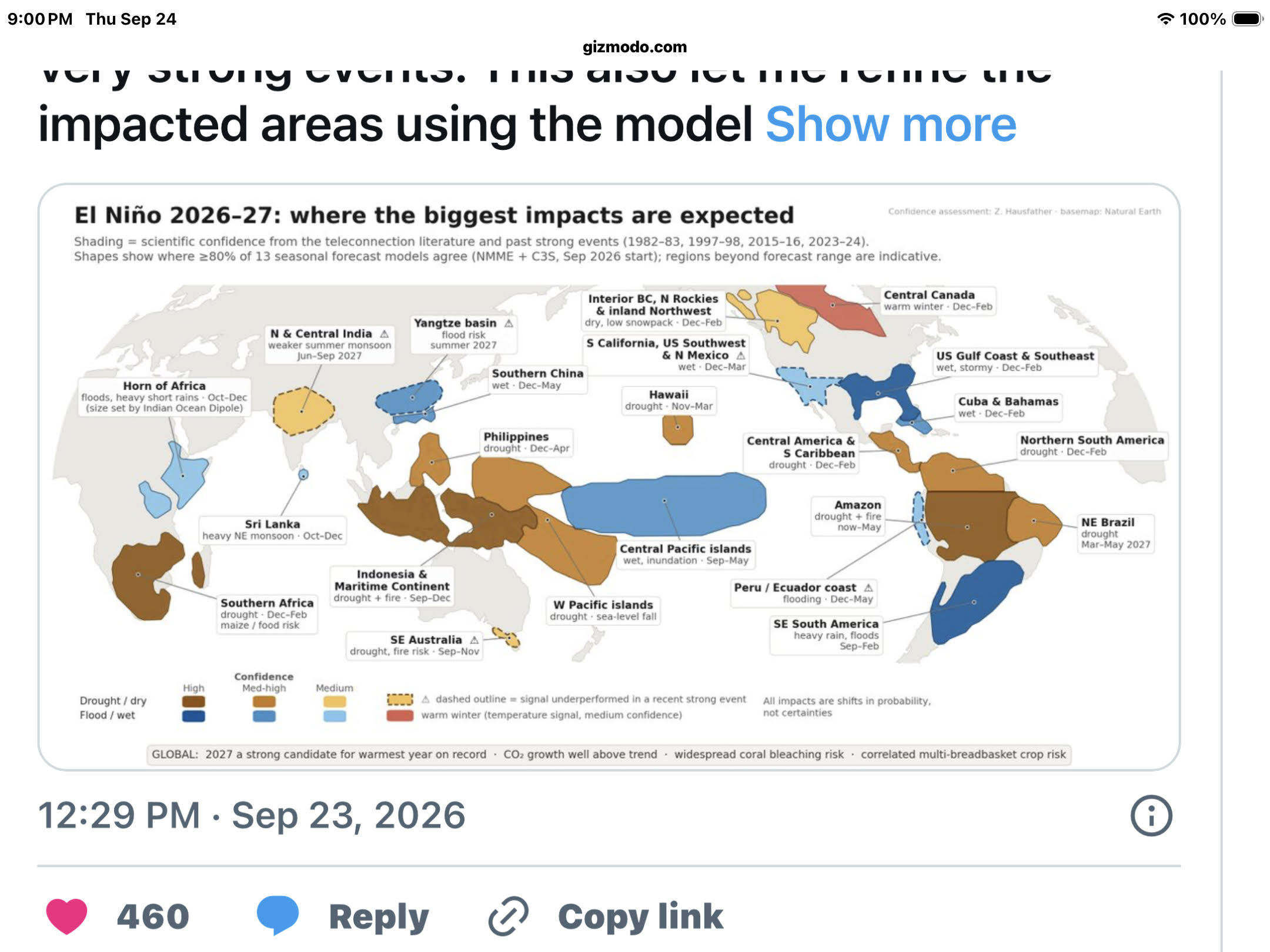
Lost Literacy in Nusantaria languagehat
Shine a Light lighthouses
Invent sesquiotica
25ix26
Science Friday
'unicontext'
...Agnes Callard is a philosopher at the University of Chicago who mostly studies Plato and Aristotle. She suggests that when modern transportation began moving people beyond their place of birth, humanity went from living within multiple contexts—home, village, place of worship, workplace—each with its own set of norms and rules for social conduct, to a “unicontext,” where the ways one should act become the same across different contexts. Although it was once unthinkable to behave in a church in the same manner as at a local bar, it is now harder to maintain such boundaries as humanity shares a massive digital space with no clear social barriers. With the rise of the unicontext, humans can be "present" all over the world at once. People become aware of a wider range of situations, offering everyone the possibility of greater recognition and different choices about life that weren't apparent before. Against this background of unicontext, negative ideas that can be framed more easily without context, such as fear and criticism, have swamped out positive ideas that require understanding the circumstances. Indeed, scientists have long recognized negativity bias as an innate psychological tendency—an inclination that works well in a unicontext world....Callard's idea leads to the rather daunting conclusion that maybe expertise and authority will never be reunited. It's hard to see how the conditions that have created the unicontext will reverse themselves. Can this be seen as anything but alarming? Or could it actually be liberating? Instead of fretting over the erosion of an amorphous concept of "trust in science" that blends expertise and authority, the right thing to focus on is how scientific expertise is alive and well, even if it no longer carries the persuasive authority it once had. Science can no longer rely on the context of its institutional status as a means of influence. In the unicontext, scientists are evaluated in the same universal room as politicians, activists, and corporations, pervaded by negativity. But science as humanity's best means of inquiry and understanding is undiminished. The better way forward is to cultivate public confidence in scientific expertise the old-fashioned way—by making promises and keeping them, being humble about what science can and cannot explain, admitting when science makes mistakes, and relentlessly striving to make sure the scientific record is reliable and well-established. Callard's hypothesis suggests that these measures are unlikely to restore scientific authority. Whether that happens will be decided not by scientists alone but by the collective citizens of the unicontext.
Ten grand challenges in aerospace information technology
...Every breath of air, every drop of rain, and every leaf absorbing sunlight is part of an intricate planetary exchange. Together, these flows of carbon, water, and energy regulate our planet's climate, sustain its ecosystems, and influence phenomena from harvests to floods, droughts, and heatwaves. Although satellite remote sensing records span multiple decades, scientists still struggle to understand how these processes interact at the planetary scale. The difficulty is that satellites provide snapshots, while Earth's systems operate as continuous processes. A forest, for example, does not simply absorb carbon. It also consumes water, releases moisture into the atmosphere, and exchanges energy with its surroundings, creating feedback that ripples across entire regions. Most of today's monitoring systems still measure carbon, water, and energy separately, missing the connections between them....scientists need to develop new methods to align and interpret diverse sources of information while accounting for uncertainty and feedback loops. By creating digital representations of the Earth, scientists could capture not only how the planet is changing, but also how human decisions drive those changes and how societies might respond.
Satellite reveals a world of altered rivers
...By simultaneously measuring the water levels and breadth of rivers around the world, the Surface Water and Ocean Topography (SWOT) satellite is exposing the true complexity of those blue lines on a map. They are dammed, braided, frozen, or drained—with behaviors that hydrologic models struggle to capture, says Colin Gleason, a hydrologist at the University of Massachusetts Amherst. Gleason led a study, published last month in Geophysical Research Letters, which found that the vast majority of rivers are not simple, idealized channels. "Human-affected weird rivers dominate the global riverscape," he says
Why AI agents invent their own language if you let them cha
...As more of these agent "swarms" are deployed, researchers have begun to turn their attention to how these communities interact— with a study released last week offering insight into how, if left to their own devices, agents start to communicate in a language that is increasingly difficult for humans to understand....Today's most advanced AI models are essentially black boxes, with such complex internal computation that even their creators don't have much grasp on why they do certain things. That makes monitoring the actual language output produced by models one of the few, albeit imperfect, tools we have to try to understand their behavior.
Giant cuttlefish's stunning mating aggregation decimated by toxic algae off Australia
...The problem is unfolding along an 8-kilometer stretch of rocky coast off Point Lowly, about 230 kilometers northwest of Adelaide. There, the genetically distinct population of the charismatic cephalopod—the world's largest cuttlefish species—breeds in a massive congregation that is sometimes as dense as one individual per square meter.
Ecological risks of the Taklamakan project
In November 2024, China finished construction of a 3046-km continuous vegetative barrier encircling the Taklamakan Desert, achieving the world's first full circumferential green closure of Earth's second-largest mobile sand desert
Via Tooze
...For 20 years, its orange groves have been ravaged by an incurable disease that causes fruit to drop before it is ripe, and leaves it tasting bitter. Florida's orange production-more than 90% of which is used for juice-is down 95% since the arrival of the disease, called citrus greening. Last year, 60,000 orange acres went out of production-26% of Florida's remaining total. Now about half a million acres are sitting dormant, and other abandoned groves have been absorbed for cattle grazing or Florida's lucrative development sprawl. This year, the U.S. Environmental Protection Agency approved two technologies that are giving the battered industry a chance at rebirth. One creates disease-resistant trees through Crispr gene editing. The other puts a harmless virus into trees to help them resist the citrus greening. Growers have ordered hundreds of thousands of resistant trees for planting in the spring, with about a million in production. Florida is giving the growers subsidies for those purchases, as part of a $330 million package over two years to revitalize the industry.
Geopolitics of data in a changing world Giles Crouch
...Countries like Canada are talking about digital sovereignty, keeping Canadian data Canadian. For decades, much of Canada's citizen and corporate data has resided in American data centres. Tariff wars and the current posture of the White House has forced Canada to reconsider, not just through laws, but Canadian companies too don't want to use American data centres. The province of Saskatchewan is about to invest over $51 Billion in a massive new data centre project.
Auguste Comte Wikipedia
...Auguste Comte did not create the idea of Sociology, the study of society, patterns of social relationships, social interaction, and culture, but instead, he expanded it greatly. Positivism, the principle of conducting sociology through empiricism and the scientific method, was the primary way that Comte studied sociology. He split sociology into two different areas of study. One, social statics, how society holds itself together, and two, social dynamics, the study of the causes of societal changes. He saw these areas as parts of the same system. Comte compared society and sociology to the human body and anatomy. "Comte ascribed the functions of connection and boundaries to the social structures of language, religion, and division of labor."[citation needed] Through language, everybody in society, both past, and present, can communicate with each other. Religion unites society under a common belief system and functions in harmony under a system. Finally, the division of labor allows everyone in society to depend upon each other.
The Origin and Meaning of Land Acknowledgements via Stephen Downes
...well worth reading for those charged with expressing land acknowledgements. The paper serves three objectives: to describe the history of land acknowledgements in the Coast Salish region of British Columbia, specifically, the ch'ech'itsul code; to identify how traditional acknowledgements are being "culturally misappropriated" to contain references to "stolen land", to express personal feelings, and to describe remorse or regret; and to describe the correct form of a land acknowledgement for the region, consisting of three parts: to introduce and situate the speaker, to acknowledge the stewards of the territory, and to explain the intent behind the event.
An in-body networking system for communication between wearable and implantable therapeutics Ramy Ghanim et al.
Editor's summary
Wearable and implantable bioelectronic devices are now used to routinely assess a person's health and, for some conditions, provide interventions as needed. An ongoing challenge is the power and device size required for wireless communication between devices. Ghanim et al. designed an electronic circuit that emulates the functionality of a nervous system. The researchers were able to remotely trigger electrical stimulation devices through pulsed signals transmitted through body tissue using less power than protocols such as Bluetooth. Implants could be injected using a syringe, and multiple devices could be controlled by using different signal patterns. —Marc S. LavineAbstract Networks of bioelectronic sensors and actuators enable closed-loop therapies that connect distant, related physiological dynamics. Currently, device interactions are limited by communication methods that inefficiently penetrate tissue and require bulky components. Inspired by the ionic signaling of the nervous system, we engineered a communication platform that uses tissue as a conductive medium to transmit signals among implants and wearables through epidermal, subcutaneous, intraperitoneal, and gastrointestinal spaces. Devices generate transient electric fields that selectively activate other devices when receiving pulses that switch on their specific transistor circuits. Implants are syringe-injectable, require negligible power consumption in listening states, and provide >10× greater tissue communication coverage than Bluetooth.
LRB 24ix26
Ranks of Humanity Thomas Meaney's review of The West: The History of an Idea by Georgios Varouxakis...Comte was one of the first modernisation theorists. According to him, the advanced portion of humanity had moved through three historical stages: the 'theological', when it attributed historical causes to divine intervention; the 'metaphysical', when it graduated to thinking in abstract philosophical concepts; and then at last the 'positive' age, when industrial development and science were able to advance 'order' and 'progress', yielding a peaceful world society. Comte believed that the only part of mankind nearing this terminus was located in Western Europe, along with its transplanted societies in the Americas and Australasia. The 'Western Republic' comprised the French, the Spanish, the Italians and, more reluctantly for him, the English and the Germans. Greece and Poland were considered honorary additions as outposts of the West....Comte needed a designation that could siphon off Latin Europe from Eastern Europe, but also include Britain and its colonial holdings in North and Latin America and Australasia. His solution was the coinage 'Occidentalité'. Comte's disciples in England at first translated the word as 'Occidentalism' (or simply 'greatness') before settling on 'Westernness'.
Keep off the grass Susan Pedersen's review of Colin Kidd's Twilight of the Dons: British Intellectuals from World War Two to Thatcherism
...An academic culture that enforces conformity to this degree seems stony soil for scholarly innovation, and in three chapters on dons' engagement with anthropology, sociology and 'America', Kidd shows that it was. Edmund Leach's brilliant work put Cambridge in the running in anthropology (though Oxbridge anthropologists were also decoyed into fruitless if amusing feuds with Claude Lévi-Strauss), but the real challenge lay in figuring out how to deal with the discipline of sociology. Sociology embodied everything Oxbridge most disliked: it was new; it employed strange methods and ‘barbarous' language; it was very much an American product. Dons had come to value America as a source of well-funded sabbaticals and lecturing gigs, but the democratic practices of an American campus sometimes shocked them: the historian Michael Howard was appalled to be told to take a tray and line up with the undergraduates at dinner in his Stanford residence hall....Talcott Parsons, who — as 'an elephantine academician, utterly lacking in the sprezzatura and lightness of touch which might charm Cambridge senior common rooms' — confirmed every prejudice. (This might seem harsh, but I had to read his translations of Max Weber at the age of eighteen, and I think it entirely justified: Parsons could not write a lucid sentence.)
...United States doesn't have anything quite like Oxford or Cambridge, but Harvard —with its comely residential 'houses' strung along the Charles River, its yards and quads, its festivities and clubs, its many lucrative endowments and prizes, its Society of Fellows modelled on All Souls — comes close. I went there at eighteen and will never cease to be grateful, not because it gave me a good education (I could have got that at many universities), but because it saved me, plucking me out of Midwestern Lutheranism, paying for the whole of my undergraduate and postgraduate education, and giving me (at one point literally) a key to one of the best libraries in the world. When I left more than two decades later, after fifteen years on the faculty and a few in administration, I missed so much about it: its heterodox but harmonious architecture, the Kabuki theatre of its faculty governance, the many doors it opened, the wealth it oozed and the fact that, when things didn't work, the person you called didn't drily say, 'Welcome to Columbia,' but: 'I can take care of that for you, Professor Pedersen.' I never regretted leaving though, not just because I found Columbia's edgy students and argumentative faculty suited me, but still more because, in New York, no one cares that you're an Ivy League professor; you're just another resident of a crumbling and glorious city. This is a great check on self-regard, and I found it unimaginably freeing.